
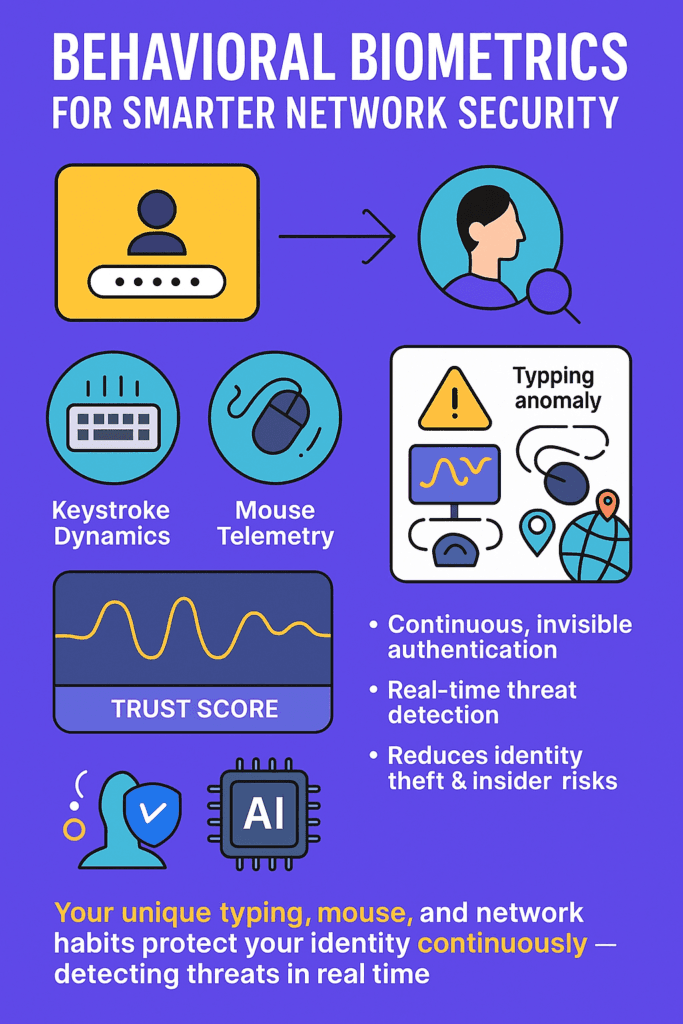
Behavioral Biometric Forensics 2026: Identifying Attackers by How They Type
The attacker had valid credentials. They passed MFA. Every authentication log shows a legitimate login. The security team can prove a breach occurred — but cannot prove who did it. In 2026, behavioral biometrics provides the answer that credentials cannot: the way a person types, moves a mouse, swipes a screen, and navigates a system is as unique as a fingerprint. And unlike a password, it cannot be stolen — only imperfectly imitated. Behavioral biometric methods can be applied to digital forensics to identify an attacker who has gained access to stolen credentials or otherwise gained unlawful access. User attribution in digital forensic analysis is the process of identifying the individual "who did what" on a given system under observation — the foundational question that behavioral forensics uniquely answers when credential-based evidence fails.
This blog explains how behavioral biometric forensics works, what evidence it generates, and how investigators are using it to solve the 2026 class of insider threat and credential-theft investigations.
The Four Behavioral Biometric Evidence Channels
Keystroke Dynamics — The Typing Fingerprint
Keystroke dynamics analyzes the unique rhythms of how an individual types — the precise timing between key presses (flight time), the duration of each key hold (dwell time), and the force applied to each key. These patterns are so individually consistent that research demonstrates reliable user identification from as few as 15 keystrokes.
In a forensic context, keystroke dynamics serves a dual purpose: identifying whether the authenticated user is actually present at the keyboard, and detecting the moment a session transitions from legitimate user to attacker — even when credentials remain valid throughout.
According to the 2026 Entrust Identity Fraud Report, one in five biometric fraud attempts involves deepfake manipulation. Injection attacks, where synthetic media is fed directly into authentication APIs, are also increasing annually. Standard biometrics are vulnerable, but 2026-grade liveness detection blocks deepfakes by analyzing micro-movements, blood flow patterns, and light reflections.
Mouse Dynamics and Touch Behavioral Patterns
Beyond keystrokes, mouse movement patterns — velocity, acceleration, curvature radius, pause frequency, and click pressure — create behavioral signatures as unique as handwriting. Mobile device touch patterns — swipe geometry, gesture timing, and grip angle — provide equivalent signatures on smartphone interfaces.
A behavior-based biometric recognition system comprises identity identification and identity verification processes. The verification process is a one-to-one matching process, while identity identification involves identifying a singular identity from a larger sample — a 1:N matching process that directly maps to forensic investigation methodology where investigators ask "which known user does this behavioral pattern match?"
Table: Behavioral Biometric Evidence Channels in DFIR
| Channel | Signal Captured | Forensic Application | Evidence Strength |
|---|---|---|---|
| Keystroke dynamics | Dwell time, flight time, error patterns | Session attribution, impersonation detection | Very High |
| Mouse dynamics | Velocity, curvature, click patterns | Workstation user identification | High |
| Touch biometrics | Swipe geometry, pressure, grip angle | Mobile device user attribution | High |
| Navigation patterns | Application workflow sequences | Insider threat behavioral profiling | Medium-High |
| Voice biometrics | Vocal frequency, rhythm, resonance | Phone-based identity verification | High |
| Gait (XR/IoT) | Motion capture walking pattern | Physical presence attribution | Very High |
Behavioral Forensics in Post-Breach Investigation
Reconstructing the True Attacker Identity
Forensic science in a digital medium often involves identification — the 1:N process of identifying a singular user from a larger population. Whilst digital forensic readiness mechanisms are a potential approach for achieving reliable behavioral biometric modality, the lack of unique signature in some behavioral channels presents limitations that multi-modal approaches must address.
In a post-breach investigation where an attacker used stolen credentials, behavioral forensics reconstructs the investigation in three steps:
- Behavioral baseline extraction — extract the legitimate user's historical behavioral patterns from pre-breach session logs (keystroke timing distributions, mouse movement signatures, navigation workflow patterns)
- Anomaly timestamp identification — compare post-breach session behavioral data against the legitimate baseline to identify the exact moment behavioral deviation began — this is the attacker's entry timestamp
- Cross-session attribution — compare the attacker's behavioral patterns against known behavioral profiles (internal users, previous incidents, external intelligence databases) to attempt positive identification
The Insider Threat Application
Behavioral biometrics is the only forensic technique that can detect insider threats where the attacker is a legitimate user with valid credentials — because insider threat detection requires distinguishing between two people using the same account, which credential-based evidence cannot do.
Pro Tip: For insider threat investigations, establish behavioral baseline logging before any incident — retroactive behavioral baseline construction from sparse historical data is significantly less reliable than baselines built from 90+ days of rich session data. Treat behavioral baseline logging as forensic evidence preservation, not just security monitoring.
Table: Behavioral Biometric Forensics vs Traditional Credential Evidence
| Investigation Scenario | Traditional Credential Evidence | Behavioral Biometric Evidence |
|---|---|---|
| Valid credentials used | Cannot distinguish legitimate from attacker | Behavioral deviation reveals attacker session |
| MFA passed | No attribution evidence | Behavioral mismatch flags impersonator |
| Insider threat | Confirms authorized access | Identifies behavioral anomaly within authorized session |
| Deepfake bypass | Authentication accepted | Liveness behavioral signals flag injection |
| Account sharing | Indistinguishable in logs | Different behavioral profiles per session |
| Post-breach attribution | Timestamp only | Full attacker behavior fingerprint |
Admissibility and Legal Framework
The Court Admissibility Challenge
Multi-modal biometric systems combining face and behavior represent the strongest line of defense against synthetic identity fraud in 2026. Continuous monitoring of biometric and behavioral signals beyond one-time onboarding allows organizations to reverify identity at risky moments — payments, password resets, and high-value transactions — limiting the window for account takeovers and synthetic profiles to operate.
In 2026, organizations are moving toward more transparent, resilient, and tightly governed biometric storage models — exploring new encryption strategies, distributed storage frameworks, and more rigorous consent and auditing controls. The question has shifted from "Should biometrics be stored?" to "How do we store them in the most secure and privacy-preserving way possible?"
For forensic admissibility, behavioral biometric evidence requires: documented baseline collection methodology, statistical validation of the identification algorithm's error rate, expert witness testimony interpreting behavioral deviation, and compliance with applicable biometric data privacy laws (GDPR Biometric Data provisions, Illinois BIPA, and similar frameworks).
Key Takeaways
- Deploy behavioral baseline logging immediately — retroactive baseline construction from sparse data is unreliable; rich 90-day baselines are required for investigative-grade attribution
- Use keystroke dynamics as the primary attribution signal — it is the most forensically validated behavioral channel with the strongest peer-reviewed identification accuracy
- Apply multi-modal behavioral analysis — combining keystroke, mouse, and navigation patterns achieves identification accuracy that no single channel provides alone
- Identify attacker session start timestamps via behavioral deviation analysis — the moment behavioral patterns diverge from the baseline is when the attacker took over the session
- Document baseline methodology for court — behavioral biometric evidence requires expert testimony and validation documentation; prepare these before any investigation, not during
- Comply with biometric data privacy law — GDPR, Illinois BIPA, and equivalent frameworks regulate behavioral biometric data collection with consent and storage requirements
Conclusion
Behavioral biometric forensics in 2026 closes the most significant gap in digital investigation: the gap between authenticated access and actual identity. When credentials fail as evidence — when every log shows a legitimate login but a breach undeniably occurred — behavioral biometrics is the discipline that identifies who was actually at the keyboard, when they arrived, and what distinguishes their session from the legitimate user's. The technique's admissibility is established, its accuracy is validated, and its investigative application to insider threats and credential-theft attacks is directly relevant to the most common breach patterns of 2026. Build your behavioral baseline now. The next investigation where you need it will not give you time to start from scratch.
Frequently Asked Questions
Q: What is behavioral biometric forensics and how does it differ from traditional biometrics? A: Traditional biometrics uses static physical characteristics — fingerprints, face geometry, iris patterns — for identity verification at a single point in time. Behavioral biometric forensics analyzes dynamic interaction patterns — keystroke timing, mouse movement curves, touch gesture geometry, and navigation workflows — to continuously identify users throughout a session. In forensic contexts, this enables investigators to detect the exact moment a session transitions from a legitimate user to an attacker, even when credentials remain valid.
Q: What is the most forensically reliable behavioral biometric channel? A: Keystroke dynamics — specifically the combination of dwell time (key hold duration) and flight time (timing between key releases and next key presses) — has the strongest peer-reviewed forensic validation record. Research consistently demonstrates reliable user identification from small keystroke samples, and the patterns are sufficiently unique to distinguish individuals sharing an account and to detect impersonation attempts in post-breach investigations.
Q: How does behavioral biometric forensics detect insider threats? A: Insider threat investigations fail with traditional credential evidence because the insider has legitimate authorization. Behavioral forensics addresses this by establishing a behavioral baseline of the legitimate user's interaction patterns during normal operations, then identifying statistically significant deviations from that baseline during the investigation window. Deviations indicate a different person — or the same person engaging in anomalous behavior — providing the attribution evidence that credential logs cannot supply.
Q: Is behavioral biometric evidence admissible in court? A: Yes, with appropriate documentation. Admissibility requires documented baseline collection methodology, statistical validation of the identification algorithm's false positive and false negative rates, qualified expert witness testimony interpreting behavioral deviation findings, and compliance with applicable biometric data privacy laws. Courts in the US and EU have accepted behavioral biometric evidence when these standards are met; the most successful cases combine behavioral biometric attribution with corroborating traditional forensic evidence.
Q: What privacy laws govern behavioral biometric data collection for forensic purposes? A: GDPR classifies behavioral biometric data as a special category of personal data requiring explicit legal basis and data subject notification. The Illinois Biometric Information Privacy Act (BIPA) requires written consent before collection and imposes strict retention and storage requirements. California CCPA provides additional rights for California residents. Forensic collection of behavioral biometric data for investigations requires documented legal authority — typically a search warrant or equivalent — in most jurisdictions, even when the data was originally collected for security monitoring with employee consent.

Enjoyed this article?
Subscribe for more cybersecurity insights.