
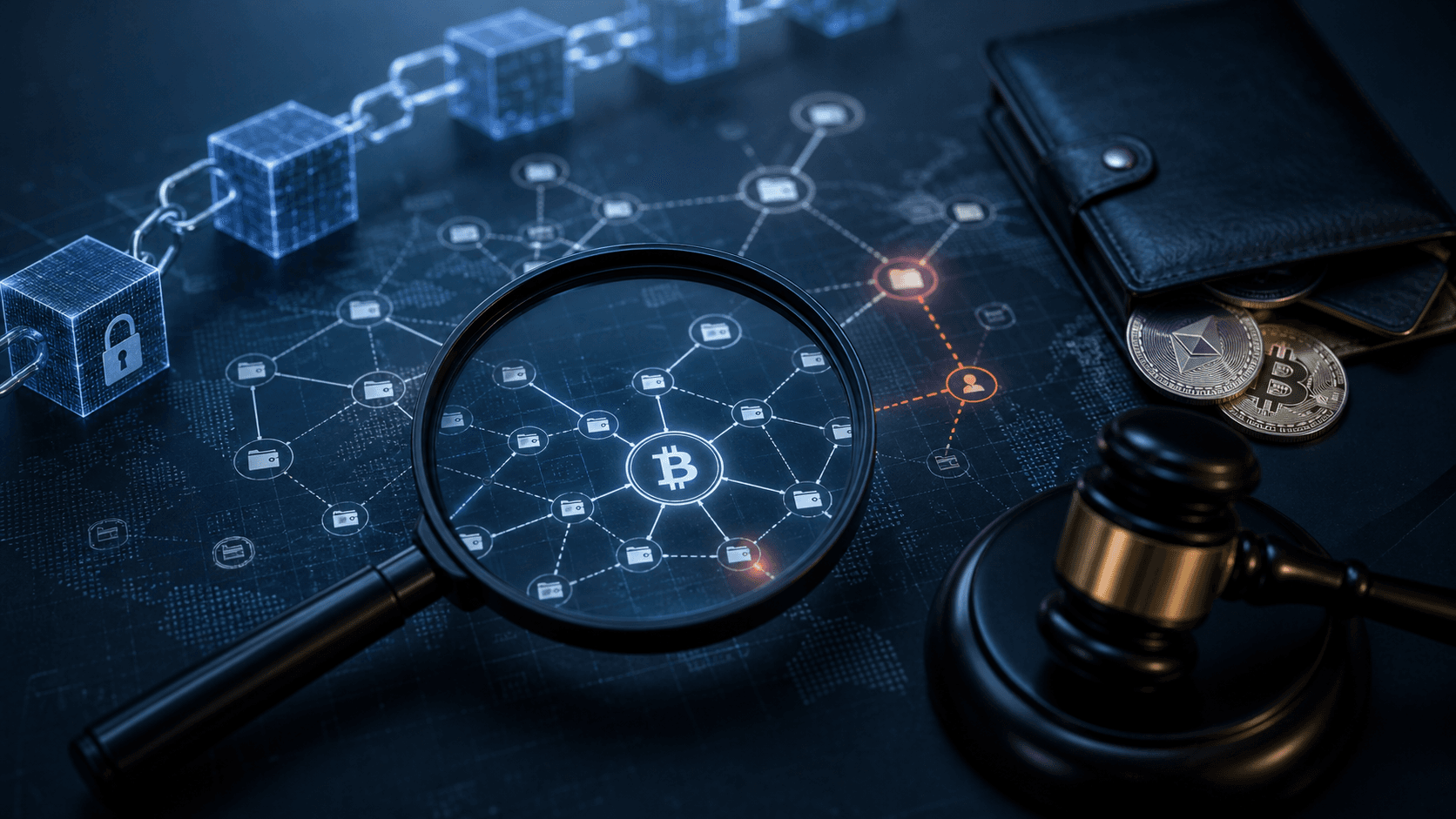
Cryptocurrency was supposed to be anonymous. It isn't — and that distinction is reshaping financial crime investigations globally. In 2023, $24.2 billion in illicit cryptocurrency transactions were recorded globally, a 37% increase from 2022. In 2024, that figure climbed further. Ransomware gangs, money launderers, darknet markets, and sanctions evaders all depend on blockchain networks — yet those same networks permanently record every transaction they make.
Blockchain forensics is the discipline that exploits this paradox. This blog explains exactly how investigators trace crypto crime across wallets, mixers, and privacy coins — and where the real technical and legal limits lie in 2026.
Why Cryptocurrency Is Pseudonymous, Not Anonymous
The Public Ledger Advantage
On public blockchains, every transaction is visible — the sender and receiver addresses, the amount, and the timestamp. Cryptocurrency is pseudonymous, not anonymous. Transactions use a public address, not a person's name — but investigators can link these pseudonymous addresses to real identities.
Every address interaction, every wallet cluster, and every exchange deposit is permanently inscribed on the chain. Unlike cash, blockchain evidence cannot be physically destroyed. A transaction from three years ago is as readable today as it was the moment it was confirmed.
Hosted Wallets as Identity Anchors
Hosted wallets on exchanges mean the exchange holds the private keys and knows the user's identity. This is where most successful crypto crime investigations conclude — at a Know Your Customer (KYC)-compliant exchange where the suspect cashed out. Subpoenas to exchanges regularly unlock the final link between a pseudonymous address and a real person.
Table: Cryptocurrency Forensics — Evidence Quality by Source
| Evidence Source | Identity Linkage | Legal Process Required |
|---|---|---|
| Centralized exchange (KYC) | High | Subpoena / legal request |
| Blockchain transaction graph | Medium | None (public data) |
| DeFi protocol logs | Low–Medium | Smart contract analysis |
| Privacy coin (Monero/Zcash) | Very Low | Advanced heuristics only |
| Crypto mixer output | Very Low | Pattern clustering |
Core Investigative Techniques in Blockchain Forensics
Transaction Graph Analysis and Cluster Tracing
Investigators map the flow of funds across wallets using transaction graph analysis — visually representing how cryptocurrency moves from a source address through intermediate hops to a final destination. Wallet clustering algorithms group addresses controlled by the same entity based on co-spending patterns and common-input-ownership heuristics.
Core techniques include cluster analysis, transaction graph analysis, and integration with KYC/AML data from exchanges. Common applications cover ransomware, money laundering, darknet markets, fraud, and terrorist financing.
Detecting Obfuscation Tactics
Criminals employ laundering tactics including CoinJoins, mixers, cross-chain swaps, and DeFi obfuscation. Investigators must identify change addresses, wallet clusters, and suspicious transaction patterns — and trace privacy coins like Monero and Zcash while understanding their forensic limitations.
Monero (XMR) transactions accounted for 42% of crypto activity on dark web markets in 2024, making it the most-used privacy coin — and the hardest to trace using conventional graph analysis.
Pro Tip: When Monero tracing hits a wall, pivot to OSINT — examining exchange KYC records, IP logs from wallet software, and on-chain timing correlations across related Bitcoin addresses the suspect controls in parallel.
Table: Crypto Obfuscation Methods vs Forensic Countermeasures
| Obfuscation Method | Investigative Countermeasure |
|---|---|
| Cryptocurrency mixer | Timing analysis, input/output clustering |
| CoinJoin | Common-input-ownership heuristics |
| Cross-chain bridge | Multi-chain graph correlation |
| DeFi protocol swap | Smart contract event log analysis |
| Privacy coin (Monero) | Network-layer timing, exchange KYC |
Legal Framework and Admissibility of Blockchain Evidence
Blockchain forensics enables real-time detection of threats and helps create audit trails that are admissible in court — making it indispensable for both detection and prosecution.
For blockchain evidence to survive courtroom scrutiny, investigators must document:
- Data source — which blockchain node or API provided the transaction data
- Methodology — which clustering algorithms and heuristics were applied
- Tool version — software and database version used at time of analysis
- Analyst qualification — certification or demonstrated expertise in blockchain analysis
- Chain of custody — all access and transfer of the investigative dataset
India's Enforcement Directorate used blockchain forensic tools to uncover $1 billion in crypto-based money laundering schemes in 2024. France's Gendarmerie Nationale established a dedicated Crypto Crime Task Force in 2024, leading to €75 million in asset recoveries.
Relevant compliance frameworks include FATF Travel Rule (wallet identity data), AML directives (5AMLD/6AMLD in EU), FinCEN guidance for US investigations, and GDPR for handling KYC data obtained from EU-based exchanges.
Key Takeaways
- Blockchain is permanently transparent — every transaction is traceable; the question is how many hops the attacker used to obscure it
- Pseudonymity, not anonymity — always pursue the KYC-linked exchange endpoint where funds land
- Master wallet clustering — co-spending and common-input heuristics break most obfuscation chains
- Privacy coins require multi-method approaches — network timing, OSINT, and parallel BTC wallet analysis
- Document everything — blockchain evidence without auditable methodology will not survive cross-examination
- Coordinate with exchanges pre-incident — established legal channels dramatically accelerate fund tracing
Conclusion
Blockchain forensics is proving that transparency is crypto crime's greatest vulnerability. The immutable ledger, the very feature that gives cryptocurrency credibility, is exactly what makes it a forensic investigator's most powerful tool. As criminals layer obfuscation through mixers, bridges, and privacy coins, investigators who combine graph analysis, OSINT, and pre-established legal coordination with exchanges will consistently follow the money to its source. Build your blockchain forensics capability now — ransomware payments, fraud proceeds, and sanctions evasion all leave a chain you can follow.
Frequently Asked Questions
Q: Is cryptocurrency really traceable by investigators? A: Yes — because all public blockchain transactions are permanently recorded, investigators can trace funds across wallets using graph analysis and clustering algorithms. The challenge is obfuscation tools like mixers and privacy coins, but these rarely defeat a well-resourced multi-method investigation.
Q: What makes blockchain evidence admissible in court? A: Admissibility depends on documented methodology, tool version transparency, analyst qualification, and a clear chain of custody for all investigative data. Courts increasingly accept blockchain evidence when these elements are properly documented by a qualified examiner.
Q: What is the hardest cryptocurrency to trace? A: Monero (XMR) is currently the most forensically resistant due to ring signatures, stealth addresses, and RingCT that obscure sender, receiver, and amount. However, network-layer timing attacks, exchange KYC at cash-out points, and parallel wallet correlation still provide viable investigative paths.
Q: What compliance frameworks govern crypto forensic investigations? A: Key frameworks include the FATF Travel Rule, EU 5AMLD/6AMLD, FinCEN guidance in the US, and national AML regulations. GDPR applies to personal data obtained from exchanges during investigations within or involving EU jurisdictions.
Q: How are DeFi protocols investigated forensically? A: DeFi protocols run on smart contracts whose event logs are publicly readable on-chain. Investigators analyze these logs to reconstruct fund flows through liquidity pools and token swaps, correlating addresses across chains using cross-chain bridge transaction records.

Enjoyed this article?
Subscribe for more cybersecurity insights.