
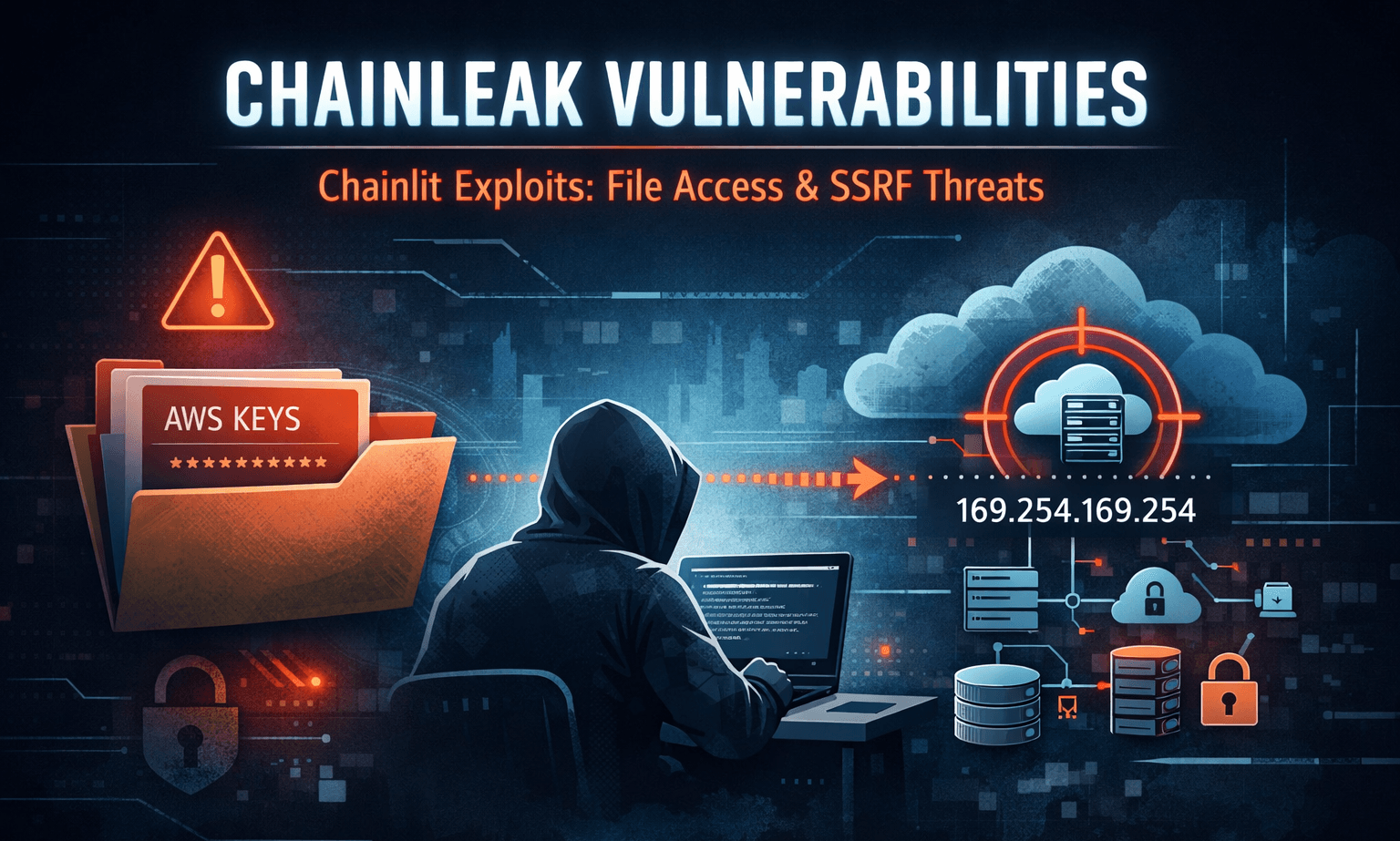
The rapid adoption of AI frameworks has created new attack vectors that most security teams haven't addressed. Two critical vulnerabilities in Chainlit—a framework downloaded 700,000 times monthly—demonstrate how a single unpatched library can expose your entire cloud infrastructure to compromise.
Chainlit powers conversational AI applications across enterprises and academic institutions worldwide. The framework's "ChainLeak" vulnerabilities allow attackers to read arbitrary files and perform server-side request forgery (SSRF). When chained together, these flaws create a pathway to full cloud environment takeover. With roughly 5 million annual downloads and many deployments internet-facing, the potential impact spans industries.
This article examines how these vulnerabilities work, their real-world implications, and the defensive measures your organization should implement immediately.
Understanding the ChainLeak Attack Surface
Chainlit provides developers with pre-built components for conversational AI applications, including chat interfaces, backend tooling, authentication mechanisms, and cloud deployment support. This convenience comes with security responsibilities that many organizations overlook during rapid AI deployment cycles.
Why AI Frameworks Present Unique Risks
AI application frameworks differ from traditional web frameworks in critical ways. They often handle sensitive data including API keys, training data, and user conversations. These applications typically integrate with multiple cloud services and internal APIs, expanding the attack surface significantly.
The urgency to deploy AI capabilities often leads organizations to prioritize functionality over security hardening. Development teams may lack expertise in securing AI-specific attack vectors. This creates environments where vulnerabilities can persist undetected across production systems.
The Scale of Chainlit Deployment
With 700,000 monthly PyPI downloads, Chainlit ranks among the most widely adopted AI frameworks. These deployments span diverse environments:
- Enterprise customer service chatbots
- Academic research platforms
- Internal knowledge management systems
- Production-facing AI assistants
- Development and testing environments
Many of these systems process confidential information or connect to privileged cloud resources. A vulnerability in the framework affects every application built on it, creating a massive attack surface for threat actors.
Anatomy of CVE-2026-22218: Arbitrary File Read
The first ChainLeak vulnerability exploits Chainlit's element handling mechanism. Understanding how this flaw works reveals broader lessons about input validation in modern frameworks.
How the Exploit Works
CVE-2026-22218 targets the /project/element endpoint. Attackers submit a crafted request containing a custom element with a controlled path parameter. The framework processes this input without proper validation, copying any file at the specified path into the attacker's session.
This design flaw bypasses typical access controls. The application runs with specific filesystem permissions, and the vulnerability allows attackers to leverage those permissions to access any readable file. No authentication or special privileges are required beyond basic access to the Chainlit application.
Critical Files at Risk
The arbitrary file read capability exposes numerous sensitive resources:
- Cloud credentials: AWS credentials files, Azure service principal keys, GCP service account tokens
- API keys: Third-party service credentials stored in configuration files
- Application secrets: Session tokens, encryption keys, database passwords
- Source code: Proprietary algorithms, business logic, additional vulnerabilities
- Configuration files: Infrastructure details, service endpoints, network topology
- Database files: SQLite databases containing user data, conversation history, authentication information
Organizations using environment variables or external secret managers gain some protection. However, many deployments still rely on filesystem-based configuration, making them vulnerable to this attack.
Exploitation Difficulty
The vulnerability requires minimal technical sophistication to exploit. Attackers need only:
- Identify a Chainlit deployment (often through header fingerprinting)
- Craft a POST request to the vulnerable endpoint
- Specify target file paths
- Download the copied files through standard session mechanisms
Automated tools can scan for and exploit this vulnerability at scale, making it attractive for both targeted attacks and opportunistic campaigns.
Anatomy of CVE-2026-22219: Server-Side Request Forgery
The second vulnerability enables SSRF attacks against Chainlit deployments using SQLAlchemy data layers. This flaw becomes particularly dangerous when combined with the file read vulnerability.
SSRF Exploitation Mechanics
CVE-2026-22219 allows attackers to manipulate the url field of custom elements. When processed, the Chainlit server performs an outbound GET request to the attacker-specified URL and stores the response. Attackers then download these responses through element download endpoints.
This creates several attack opportunities. Internal REST APIs become accessible to external attackers. Cloud metadata endpoints can be queried to extract credentials. Internal network topology can be mapped through systematic probing.
Internal Service Reconnaissance
SSRF vulnerabilities grant attackers visibility into networks they shouldn't access:
Table: SSRF Target Categories
| Target Type | Example Endpoints | Information Gained |
|---|---|---|
| Cloud Metadata | 169.254.169.254/latest/meta-data | Instance credentials, role information |
| Internal APIs | internal-api.company.local/admin | Administrative functions, data access |
| Database Servers | db.internal:5432 | Connection details, version information |
| Configuration Services | consul.internal:8500 | Service discovery, secrets |
| Container Orchestration | kubernetes.default.svc | Cluster access, pod information |
Attackers typically start with cloud metadata endpoints, which provide temporary credentials with potentially broad permissions. These credentials enable lateral movement within the cloud environment.
Bypassing Network Segmentation
Many organizations rely on network segmentation as a primary defense. SSRF attacks bypass these controls by leveraging the application server's legitimate network position. The compromised Chainlit instance becomes a pivot point into supposedly protected network segments.
This is particularly problematic in cloud environments where instance roles grant broad permissions. An application server might have read access to S3 buckets, permissions to invoke Lambda functions, or the ability to describe EC2 instances—all exploitable through SSRF.
The ChainLeak Attack Chain: From Vulnerability to Cloud Compromise
Individual vulnerabilities are concerning, but their combination creates devastating attack scenarios. Zafran Labs demonstrated how chaining CVE-2026-22218 and CVE-2026-22219 enables full cloud environment compromise.
Step-by-Step Attack Progression
Phase 1: Initial Reconnaissance
Attackers identify Chainlit deployments through passive fingerprinting or active scanning. HTTP headers, error messages, and URL patterns reveal framework usage. Public cloud IP ranges are systematically probed for exposed Chainlit instances.
Phase 2: Credential Theft
Using CVE-2026-22218, attackers extract filesystem-based credentials. Priority targets include AWS credentials files (~/.aws/credentials), application configuration files, and environment variable dumps. Even partial credential exposure provides initial access.
Phase 3: Internal Network Mapping
CVE-2026-22219 enables systematic probing of internal networks. Attackers enumerate internal IP ranges, identify running services, and locate administrative interfaces. Cloud metadata endpoints reveal instance roles and available permissions.
Phase 4: Privilege Escalation
Stolen credentials are tested against cloud APIs to determine permission scope. Attackers seek roles with elevated privileges, secrets management access, or the ability to modify infrastructure. Container orchestration platforms become high-value targets.
Phase 5: Lateral Movement
With internal access established, attackers pivot to additional resources. Database servers, container registries, and CI/CD systems are common secondary targets. Each compromised system may contain credentials for further expansion.
Phase 6: Persistence and Exfiltration
Attackers establish persistent access through backdoor accounts, modified IAM policies, or compromised container images. Sensitive data is identified and exfiltrated. In some cases, attackers deploy cryptominers or ransomware.
Real-World Impact Scenarios
Consider a healthcare organization running a patient-facing AI chatbot on Chainlit. An attacker exploits ChainLeak to access AWS credentials stored in application configuration files. These credentials provide read access to S3 buckets containing patient health records.
Using SSRF, the attacker discovers an internal admin API running on a non-routable IP. This API lacks authentication when accessed from the internal network, a common misconfiguration. The attacker extracts database credentials and gains access to the complete patient database.
The breach goes undetected for weeks because the malicious activity originates from a legitimate application server. Traditional network monitoring sees only authorized connections. The organization eventually discovers the compromise through anomalous AWS API calls flagged by cloud security monitoring.
Table: Attack Chain Progression Timeline
| Phase | Duration | Activities | Detection Difficulty |
|---|---|---|---|
| Reconnaissance | Hours | Identify targets, fingerprint versions | Low (passive scanning) |
| Initial Exploitation | Minutes | Extract credentials via file read | Medium (may generate logs) |
| Internal Mapping | Hours-Days | SSRF probing, service enumeration | Medium (unusual outbound requests) |
| Privilege Escalation | Days | Test credentials, identify targets | High (appears legitimate) |
| Lateral Movement | Days-Weeks | Compromise additional systems | High (internal traffic) |
| Persistence & Impact | Ongoing | Data exfiltration, maintain access | Variable (depends on logging) |
Defensive Strategies and Mitigation Measures
Organizations must implement multiple defensive layers to protect against ChainLeak and similar framework vulnerabilities. Relying on patches alone provides insufficient protection.
Immediate Remediation Steps
Update Chainlit Immediately
Upgrade to Chainlit version 2.9.4 or later. The vulnerabilities were fixed on December 24, 2025, following disclosure on November 23, 2025. Version 2.9.6 represents the latest release as of January 2026. Delay creates unnecessary risk.
Audit Existing Deployments
Identify all Chainlit instances across development, staging, and production environments. Many organizations discover shadow deployments during these audits. Container registries, CI/CD pipelines, and developer workstations often contain forgotten instances.
Review Access Logs
Examine application logs for suspicious /project/element requests with unusual path parameters. Look for outbound connections to unexpected destinations, particularly internal IP ranges or cloud metadata endpoints. Correlation with cloud service logs may reveal credential abuse.
Architectural Security Improvements
Implement Defense in Depth
Never rely on framework security alone. Deploy multiple protective layers including web application firewalls, network segmentation, and least-privilege access controls. Each layer should operate independently to prevent single points of failure.
Adopt Secrets Management
Eliminate filesystem-based credentials entirely. Use dedicated secrets management services like AWS Secrets Manager, Azure Key Vault, or HashiCorp Vault. These systems provide centralized control, automatic rotation, and comprehensive audit logging.
Network Segmentation
Isolate AI application servers on dedicated network segments with strict egress filtering. Block access to cloud metadata endpoints from application servers. Require explicit allowlisting for all outbound connections.
Table: Security Control Framework
| Control Layer | Implementation | Protection Against |
|---|---|---|
| Application | Input validation, secure coding | Direct exploitation attempts |
| Network | Segmentation, egress filtering | SSRF, lateral movement |
| Access | Least privilege, secrets management | Credential theft impact |
| Monitoring | SIEM, anomaly detection | Ongoing attacks, persistence |
| Response | Incident playbooks, automation | Breach containment, recovery |
Continuous Security Practices
Dependency Management
Maintain an inventory of all framework dependencies. Monitor security advisories for these components. Automate vulnerability scanning in CI/CD pipelines to catch issues before production deployment.
Regular Security Assessments
Conduct penetration testing focused on AI-specific attack vectors. Traditional web application testing may miss framework-specific vulnerabilities. Engage security researchers familiar with AI application architectures.
Security Training
Educate development teams about AI framework security risks. Many developers lack awareness of SSRF, path traversal, and other vulnerabilities common in these systems. Include AI security modules in training programs.
Detection and Monitoring
Implement Behavioral Analytics
Monitor for unusual file access patterns, especially reads of credential files or configuration directories. Track outbound connection attempts to internal IP ranges. Cloud API calls from application servers deserve scrutiny.
Set Up Alerting
Configure alerts for suspicious indicators including multiple failed authentication attempts using application credentials, SSRF-typical request patterns, and access to cloud metadata endpoints. Response time determines breach impact.
Log Aggregation
Centralize logs from applications, network devices, and cloud services. Correlation across these sources reveals attack chains that individual logs might miss. Retention policies should support forensic investigation.
Key Takeaways
- Update all Chainlit deployments to version 2.9.4 or later immediately to patch critical vulnerabilities
- Eliminate filesystem-based secrets in favor of dedicated secrets management services
- Implement network segmentation and egress filtering to limit SSRF attack potential
- Deploy comprehensive monitoring to detect exploitation attempts and unauthorized access
- Conduct regular security assessments focused on AI framework-specific vulnerabilities
- Maintain current inventories of all AI framework dependencies across your environment
Conclusion
The ChainLeak vulnerabilities demonstrate how AI framework security gaps can cascade into full cloud environment compromise. Organizations rushing to deploy AI capabilities often overlook security fundamentals, creating exploitable attack surfaces.
The combination of arbitrary file read and SSRF transforms two moderate vulnerabilities into a critical threat. With 700,000 monthly downloads, Chainlit's widespread adoption means these vulnerabilities affect organizations across industries. The attack chain from initial exploitation to cloud takeover is well-defined and achievable by moderately skilled attackers.
Immediate patching is essential but insufficient. Organizations must adopt comprehensive security practices including secrets management, network segmentation, and continuous monitoring. Treat AI frameworks with the same security rigor applied to traditional web applications. Your cloud environment's security depends on the weakest component in your stack.
Frequently Asked Questions
Q: How can I determine if my Chainlit deployment was compromised?
A: Review application logs for unusual /project/element requests with filesystem paths and unexpected outbound connections to internal IPs or cloud metadata endpoints. Check cloud service logs for API calls using application credentials during suspicious timeframes. Consider engaging incident response professionals for thorough forensic analysis if you find indicators of compromise.
Q: Are Chainlit deployments using external authentication still vulnerable?
A: Yes, authentication mechanisms don't prevent exploitation of these vulnerabilities. The flaws exist in core framework functionality accessible to any authenticated user. Even with strong authentication, an attacker who gains legitimate access can exploit these vulnerabilities to escalate privileges and move laterally.
Q: What's the fastest way to protect Chainlit deployments before patching?
A: Implement web application firewall rules to block requests to /project/element with suspicious path parameters and restrict outbound network access from application servers to only explicitly required destinations. Remove or relocate sensitive files from the application server filesystem. These measures provide temporary protection but patching remains essential.
Q: Do these vulnerabilities affect Chainlit deployments in containers?
A: Yes, containerized deployments remain vulnerable unless updated to version 2.9.4 or later. Containers may actually increase risk if they include baked-in credentials or have access to container orchestration APIs. Review container images for embedded secrets and ensure orchestration platforms follow least-privilege principles.
Q: Should organizations avoid using Chainlit after these vulnerabilities?
A: No, the vulnerabilities have been patched and responsible disclosure practices were followed. All software contains occasional security flaws. Focus on maintaining current versions, implementing defense-in-depth security controls, and following secure development practices rather than avoiding specific frameworks based on historical vulnerabilities.

Enjoyed this article?
Subscribe for more cybersecurity insights.