
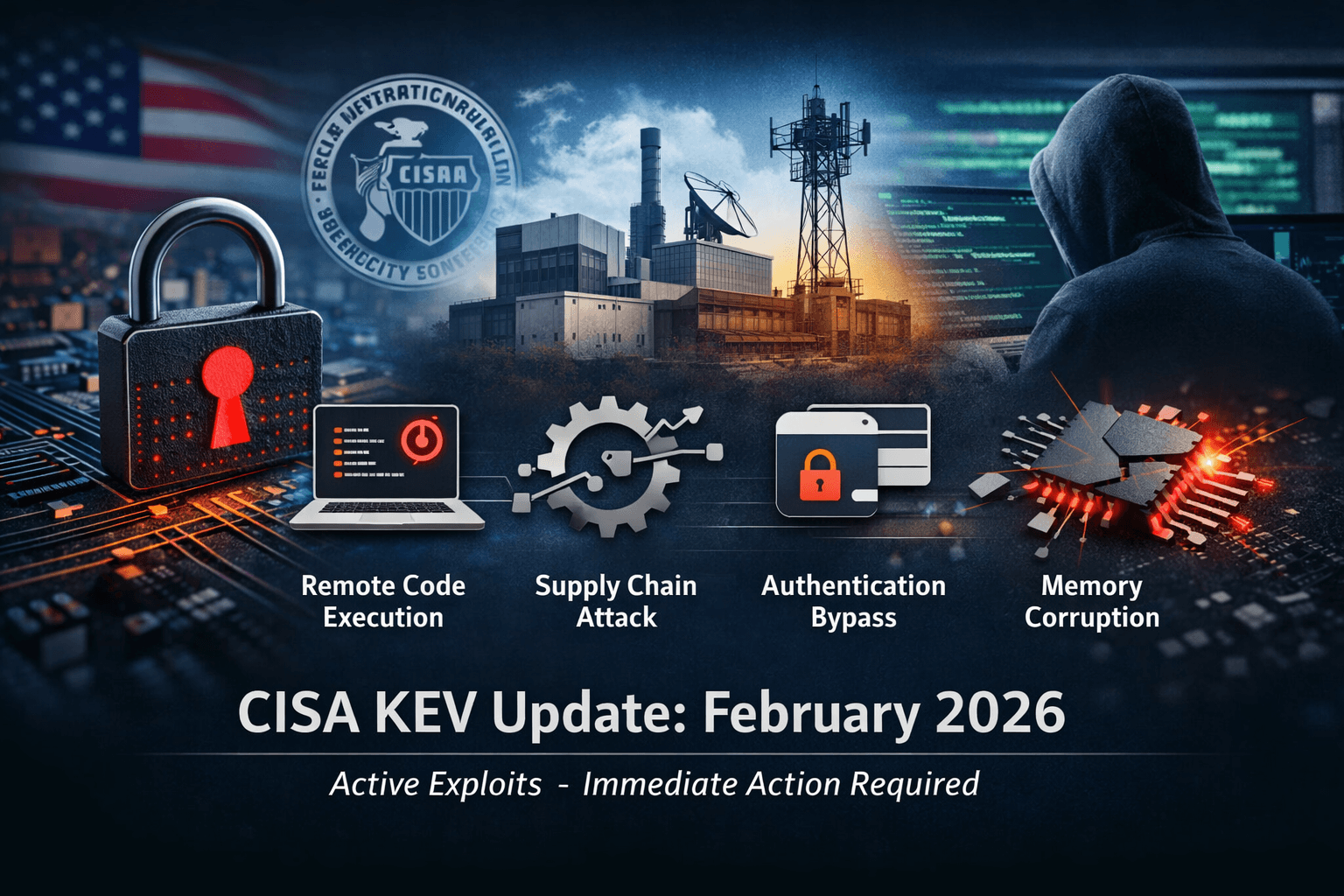
On February 12, 2026, the Cybersecurity and Infrastructure Security Agency (CISA) added four actively exploited vulnerabilities to its Known Exploited Vulnerabilities (KEV) catalog, triggering urgent patching mandates for federal agencies under Binding Operational Directive (BOD) 22-01. These flaws, affecting multiple vendors and enabling remote code execution (RCE) and supply chain attacks, are already being leveraged by threat actors in the wild. Organizations across critical infrastructure sectors face heightened compromise risks if remediation efforts are delayed.
This latest KEV update underscores a troubling trend: attackers are moving faster than ever to weaponize vulnerabilities before patches can be deployed. With zero-day exploitation becoming the norm rather than the exception, security teams must treat these additions as top-priority items in their vulnerability management programs. Understanding the nature of these threats, their potential impact, and the steps required for effective mitigation is no longer optional—it's mission-critical for maintaining organizational resilience.
Understanding CISA's KEV Catalog and BOD 22-01
The KEV catalog serves as the authoritative source for vulnerabilities that pose active, confirmed threats to federal networks and critical infrastructure. When CISA adds entries to this list, it signals that exploitation is occurring in real-world attacks, not theoretical scenarios.
The Purpose and Authority of BOD 22-01
Binding Operational Directive 22-01, issued in November 2021, mandates that all federal civilian executive branch (FCEB) agencies remediate KEV-listed vulnerabilities within prescribed timeframes. This directive represents a fundamental shift from advisory-based vulnerability management to compliance-driven remediation.
Federal agencies must patch KEV vulnerabilities according to CISA's specified deadlines, typically ranging from 14 to 21 days depending on severity. While BOD 22-01 legally applies only to federal entities, private sector organizations increasingly adopt KEV-based prioritization as a best practice for threat-informed defense.
Why KEV Listings Matter Beyond Federal Compliance
The vulnerabilities CISA adds to the KEV catalog represent active exploitation campaigns that threaten all organizations, not just government agencies. Threat actors don't limit their targeting based on sector—once a vulnerability proves exploitable, it becomes a universal attack vector.
According to recent threat intelligence (Industry Reports, 2025), vulnerabilities appear in the KEV catalog an average of 42 days after public disclosure, but exploitation often begins within hours of proof-of-concept publication. This compression of the exploit timeline leaves security teams with minimal reaction windows.
The February 12, 2026 Additions: What Makes Them Critical
The four vulnerabilities added on February 12, 2026 share several concerning characteristics:
- Active exploitation confirmed: CISA only adds vulnerabilities with verified in-the-wild exploitation
- Multi-vendor impact: These flaws affect products from different manufacturers, expanding the attack surface
- RCE capabilities: Remote code execution allows attackers to gain complete system control without user interaction
- Supply chain implications: Compromised components can cascade through interconnected business ecosystems
Organizations must recognize that these aren't emerging threats—they're active attack campaigns that security teams must address immediately.
The Four Vulnerabilities: Technical Analysis and Impact
Understanding the specific nature of each vulnerability enables security teams to assess organizational risk accurately and prioritize remediation efforts based on environmental exposure.
Vulnerability Classification and Attack Vectors
The February 2026 KEV additions span multiple attack surfaces, requiring different defensive strategies:
Table: KEV Vulnerability Attack Surface Analysis
| Attack Vector | Exploitation Complexity | Authentication Required | Network Accessibility | Typical Impact |
|---|---|---|---|---|
| RCE via Web Interface | Low | No | Internet-facing | Complete system compromise |
| Supply Chain Component | Medium | Varies | Embedded in products | Widespread lateral movement |
| Authentication Bypass | Low | No | Network-accessible | Privilege escalation |
| Memory Corruption | Medium | No | Client-side interaction | Code execution |
Remote Code Execution Vulnerabilities
RCE flaws represent the most severe category of security vulnerabilities because they allow attackers to execute arbitrary code on target systems without requiring physical access or user credentials. In the context of the February 2026 KEV update, these vulnerabilities enable threat actors to:
- Deploy ransomware payloads across enterprise networks
- Establish persistent backdoors for long-term access
- Exfiltrate sensitive data without detection
- Pivot to additional systems within the environment
Organizations with internet-facing assets running affected software face immediate risk. Security teams should assume that scanning and exploitation attempts began the moment these vulnerabilities entered the KEV catalog.
Supply Chain Attack Implications
Supply chain vulnerabilities create cascading risk because a single compromised component can affect thousands of downstream customers. The February 2026 additions include flaws in widely deployed software libraries and third-party components that appear in numerous enterprise applications.
Important: Many organizations lack complete visibility into their software bill of materials (SBOM), making it difficult to identify all instances of vulnerable components. This blind spot significantly extends remediation timelines and leaves organizations exposed.
Real-World Exploitation Scenarios
Based on threat intelligence patterns (Cybersecurity Vendors, 2025), here's how attackers typically exploit these vulnerability types:
- Initial reconnaissance: Automated scanning identifies vulnerable systems within hours of KEV publication
- Weaponization: Exploit code, often publicly available, gets integrated into attack frameworks
- Delivery: Mass exploitation campaigns target vulnerable internet-facing systems
- Installation: Successful exploits deploy web shells, ransomware, or remote access trojans
- Command and control: Compromised systems connect to attacker infrastructure
- Actions on objectives: Data theft, ransomware deployment, or lateral movement begins
The time from KEV listing to active exploitation in enterprise environments now averages less than 72 hours (Security Research Firms, 2025).
Compliance Requirements and Remediation Deadlines
Federal agencies operating under BOD 22-01 face strict compliance timelines, but all organizations should adopt similar urgency in their response protocols.
Federal Agency Obligations
CISA typically assigns remediation deadlines based on vulnerability severity and exploitability. For the February 12, 2026 KEV additions, federal agencies must:
- Complete vulnerability scanning across all systems within 48 hours
- Develop remediation plans identifying all affected assets within 72 hours
- Apply patches or implement mitigating controls within the specified deadline (typically 14-21 days)
- Report compliance status through authorized channels
Failure to meet these deadlines can result in system authorization removal, requiring agencies to disconnect non-compliant systems from federal networks.
Private Sector Best Practices
While BOD 22-01 doesn't legally bind private organizations, industry leaders increasingly align their vulnerability management programs with CISA's KEV-driven approach. This alignment provides several advantages:
- Threat-informed prioritization based on active exploitation
- Alignment with cyber insurance requirements
- Demonstrable due diligence for regulatory compliance
- Enhanced security posture against real-world threats
Table: Recommended Remediation Timeline Comparison
| Organization Type | Discovery Phase | Assessment Phase | Remediation Phase | Verification Phase |
|---|---|---|---|---|
| Federal Agency (BOD 22-01) | 48 hours | 72 hours | 14-21 days | Immediate |
| Critical Infrastructure | 72 hours | 5 days | 21 days | 7 days post-patch |
| Enterprise (General) | 5 days | 7 days | 30 days | 14 days post-patch |
| SMB Organizations | 7 days | 10 days | 45 days | 21 days post-patch |
Regulatory and Compliance Considerations
Beyond BOD 22-01, organizations must consider how KEV vulnerabilities intersect with other compliance frameworks:
- HIPAA: Healthcare entities face breach notification requirements if KEV vulnerabilities lead to protected health information (PHI) exposure
- PCI DSS: Payment card industry standards require timely patching of critical vulnerabilities affecting cardholder data environments
- GDPR: European organizations must demonstrate appropriate technical measures, including prompt vulnerability remediation
- SOC 2: Service organizations must maintain effective vulnerability management controls as part of security commitments
Documented response to KEV listings demonstrates compliance with these frameworks' security requirements.
Enterprise Response Strategy: From Detection to Remediation
Effective response to KEV updates requires coordinated action across multiple teams and security functions. Organizations need structured processes that move from identification through verification.
Immediate Actions: First 24-48 Hours
When CISA publishes KEV updates, security operations centers (SOCs) and vulnerability management teams should execute a rapid response protocol:
Hour 0-4: Initial Assessment
- Review CISA's KEV announcement for technical details
- Identify affected products and versions in the asset inventory
- Determine internet-facing exposure and attack surface
- Escalate to incident response teams if exploitation is detected
Hour 4-24: Comprehensive Scanning
- Deploy vulnerability scanners across all network segments
- Query configuration management databases (CMDBs) for affected software
- Engage with application owners to identify embedded components
- Document all identified vulnerable instances with business context
Hour 24-48: Risk Prioritization
- Classify affected systems by criticality and exposure
- Assess compensating controls currently in place
- Develop remediation sequencing based on risk scoring
- Brief executive leadership on organizational exposure
Vulnerability Assessment and Asset Inventory
Accurate asset inventory forms the foundation of effective vulnerability response. Organizations struggling with KEV remediation often lack comprehensive visibility into their technology estate.
Pro Tip: Maintain an automated asset discovery process that updates continuously rather than relying on periodic manual inventories. Cloud environments, in particular, change too rapidly for static documentation.
Key inventory components for KEV response include:
- Software versions for all applications and operating systems
- Network topology showing internet-facing versus internal systems
- Business criticality ratings for each asset
- Data classification labels indicating sensitive information
- Patch management responsibility assignments
Patch Management and Change Control
Applying security patches requires balancing speed with stability. While urgency is critical for KEV vulnerabilities, organizations must still follow change management protocols to avoid operational disruptions.
Table: Patch Deployment Strategy by Environment Type
| Environment | Testing Required | Approval Process | Deployment Window | Rollback Plan |
|---|---|---|---|---|
| Production (Critical) | Full regression testing | CAB approval | Scheduled maintenance | Mandatory |
| Production (Standard) | Smoke testing | Manager approval | Weekly patch window | Recommended |
| Development/Test | Minimal testing | Team lead approval | Immediate | Optional |
| Internet-facing | Expedited testing | Emergency change | Within 24-48 hours | Mandatory |
When Patches Aren't Available: Mitigation Controls
Some KEV vulnerabilities affect products where patches aren't immediately available or where organizational constraints prevent rapid patching. In these scenarios, compensating controls become essential:
- Network segmentation: Isolate vulnerable systems from internet access and sensitive networks
- Web application firewalls (WAF): Deploy virtual patches that block known exploit patterns
- Access controls: Restrict user permissions to minimize exploitation impact
- Enhanced monitoring: Implement detection rules for exploitation indicators of compromise (IOCs)
- System isolation: Disconnect non-essential vulnerable systems until patches deploy
These controls should be considered temporary measures, not permanent solutions. Organizations must still plan for complete remediation.
Verification and Continuous Monitoring
Remediation efforts remain incomplete until teams verify patch deployment and confirm vulnerability elimination. This verification phase should include:
- Rescanning all previously vulnerable systems to confirm patch application
- Testing exploitation attempts in controlled environments to validate fixes
- Reviewing security logs for any signs of pre-patch exploitation
- Updating asset inventory to reflect current patch levels
- Documenting remediation activities for compliance and audit purposes
Continuous monitoring ensures that new instances of vulnerable software don't reappear through software deployments, cloud provisioning, or shadow IT activities.
Broader Implications for Critical Infrastructure Protection
The February 2026 KEV update affects organizations across all sixteen critical infrastructure sectors defined by CISA. The interconnected nature of modern infrastructure means vulnerability in one sector can cascade to others.
Sector-Specific Considerations
Different critical infrastructure sectors face unique challenges in responding to KEV vulnerabilities:
Energy and Utilities: Industrial control systems (ICS) and operational technology (OT) environments often can't tolerate the downtime required for emergency patching. These organizations must rely heavily on network segmentation and compensating controls while planning maintenance windows.
Healthcare: Medical devices and hospital information systems operate under strict uptime requirements. Healthcare organizations balance patient safety concerns against cybersecurity risks, making patch timing particularly challenging.
Financial Services: The financial sector faces regulatory requirements for rapid vulnerability remediation but must maintain transaction processing availability. Many institutions maintain hot-standby systems to enable zero-downtime patching.
Manufacturing: Supply chain dependencies mean manufacturing vulnerabilities can affect both upstream suppliers and downstream customers. Industry 4.0 environments with connected production systems face particularly acute risks.
Cross-Sector Dependencies and Cascading Risks
Modern infrastructure sectors depend on each other in complex ways. A compromise in one sector can rapidly affect others:
- Energy disruptions impact healthcare facility operations and data center availability
- Financial system compromises affect payment processing across all sectors
- Transportation network attacks disrupt supply chains and emergency services
- Communications infrastructure failures cascade to all dependent sectors
This interconnection means that organizations must consider KEV vulnerabilities not just within their own environments but also in their critical suppliers and service providers.
The Role of Information Sharing
Effective critical infrastructure protection requires robust information sharing between government agencies, private sector organizations, and industry groups. CISA facilitates this through several mechanisms:
- Information Sharing and Analysis Centers (ISACs) provide sector-specific threat intelligence
- Automated Indicator Sharing (AIS) distributes machine-readable threat data
- Cybersecurity and Infrastructure Security Agency (CISA) regional offices offer localized support
- Joint Cyber Defense Collaborative brings together public and private defenders
Organizations should actively participate in these information sharing communities to gain early warning of emerging threats and learn from others' remediation experiences.
Key Takeaways
- Immediate action required: The February 12, 2026 KEV additions represent active exploitation campaigns requiring urgent response across all organizations, not just federal agencies
- Comprehensive asset visibility is essential: Organizations cannot remediate vulnerabilities they don't know exist; maintaining accurate, automated asset inventories is foundational to effective vulnerability management
- Prioritize based on exposure and criticality: Internet-facing systems and those processing sensitive data require immediate attention, followed by internal systems based on business impact
- Implement defense in depth: When immediate patching isn't possible, deploy network segmentation, virtual patching, and enhanced monitoring as compensating controls
- Align with KEV-driven prioritization: Adopt CISA's KEV catalog as the primary driver for vulnerability remediation urgency, regardless of organizational sector
- Document compliance activities: Maintain detailed records of vulnerability discovery, remediation efforts, and verification activities to demonstrate due diligence for regulatory and audit purposes
Conclusion
The February 12, 2026 CISA KEV update serves as a critical reminder that vulnerability management must operate at the speed of modern threat actors. With four actively exploited vulnerabilities now confirmed in the wild—enabling remote code execution and supply chain attacks—organizations across all sectors face immediate risk. Federal agencies operate under strict BOD 22-01 compliance deadlines, but private sector entities should adopt equal urgency in their response.
The compression of the exploit timeline from vulnerability disclosure to active exploitation means that traditional monthly patch cycles no longer provide adequate protection. Security teams must pivot to threat-informed, intelligence-driven vulnerability management that prioritizes KEV-listed flaws above all others. This shift requires investment in automated asset discovery, continuous vulnerability scanning, and streamlined change management processes that balance security urgency with operational stability.
Organizations that treat CISA's KEV updates as authoritative guidance for remediation prioritization will significantly reduce their attack surface and demonstrate measurable improvement in their security posture. The time to act is now—every hour of delay increases the likelihood that threat actors will successfully exploit these known vulnerabilities within your environment.
Frequently Asked Questions
Q: How quickly must federal agencies respond to KEV catalog additions under BOD 22-01?
A: Federal civilian executive branch agencies must remediate KEV-listed vulnerabilities within the timeframe specified by CISA, typically 14-21 days from the addition date. Agencies must complete initial scanning within 48 hours and develop remediation plans within 72 hours. Non-compliance can result in system authorization removal and network disconnection requirements.
Q: Should private sector organizations follow the same remediation timelines as federal agencies for KEV vulnerabilities?
A: While BOD 22-01 doesn't legally bind private organizations, cybersecurity best practices and many cyber insurance policies now require KEV-aligned vulnerability management. Critical infrastructure organizations should adopt similar urgency, typically targeting remediation within 21-30 days. The KEV catalog represents confirmed active exploitation, making these vulnerabilities higher priority than standard CVE listings.
Q: What should organizations do if patches aren't available for KEV-listed vulnerabilities affecting their systems?
A: Organizations must implement compensating controls including network segmentation to isolate vulnerable systems, web application firewalls or intrusion prevention systems with virtual patches, restrictive access controls, and enhanced monitoring for exploitation attempts. These measures should be considered temporary until vendor patches become available. Document all compensating controls for compliance and audit purposes.
Q: How does the KEV catalog differ from the National Vulnerability Database (NVD) or CVE listings?
A: The NVD and CVE system catalog all publicly disclosed vulnerabilities regardless of exploitation status, while CISA's KEV catalog exclusively lists vulnerabilities with confirmed active exploitation in the wild. KEV inclusion signals that threat actors are currently using these vulnerabilities in attacks, requiring immediate prioritization over theoretical vulnerabilities. Organizations should use KEV as their primary remediation driver.
Q: What are the consequences if a KEV vulnerability is exploited before an organization can apply patches?
A: Successful exploitation of KEV vulnerabilities can result in complete system compromise, data breaches requiring regulatory notification, ransomware deployment, lateral movement to additional systems, and potential compliance violations. Organizations may face cyber insurance claim challenges if they cannot demonstrate timely remediation efforts. Post-exploitation, organizations must conduct incident response activities, forensic analysis, and potentially system rebuilds from clean backups.

Enjoyed this article?
Subscribe for more cybersecurity insights.