
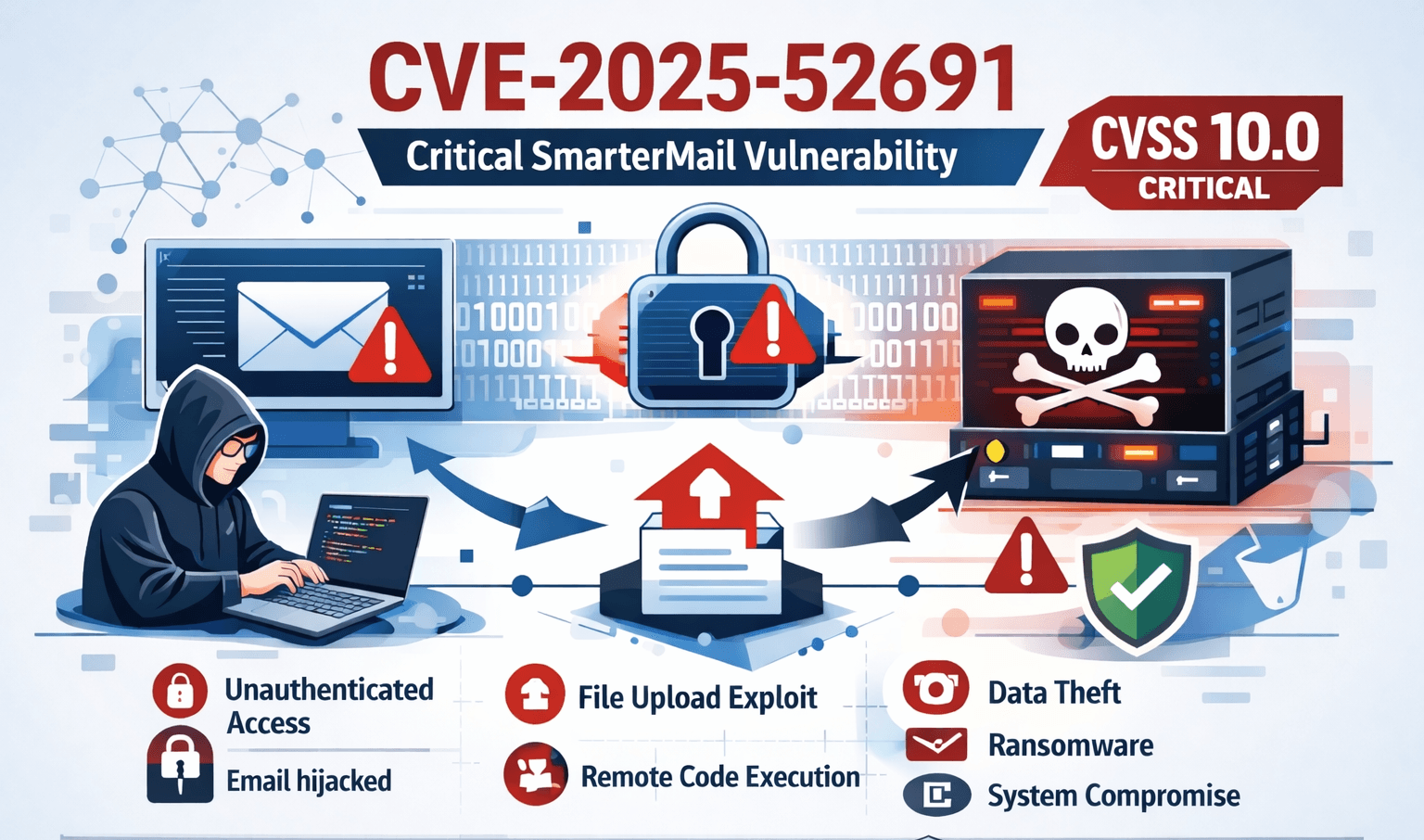
On December 30, 2025, the Cyber Security Agency of Singapore issued an urgent alert about CVE-2025-52691, a vulnerability in SmarterMail that achieved the rare and alarming distinction of a perfect 10.0 CVSS score. This maximum severity rating means attackers can compromise mail servers without authentication, credentials, or user interaction. The flaw allows arbitrary file uploads to any server location, leading directly to remote code execution.
With email servers handling sensitive communications and often serving as entry points to corporate networks, this vulnerability represents a critical threat. SmarterMail installations running Build 9406 or earlier are exposed to exploitation that could result in data theft, ransomware deployment, or complete system compromise. Organizations using this enterprise email solution must understand the technical details, assess their exposure, and implement patches immediately.
Understanding CVE-2025-52691: Technical Analysis
What Makes This Vulnerability Critical
CVE-2025-52691 combines three dangerous characteristics that security professionals fear most. The vulnerability requires no authentication, operates over standard network protocols, and demands zero user interaction. Attackers can exploit this flaw by simply sending HTTP requests to vulnerable servers exposed to the internet.
The core issue stems from improper file upload validation classified as CWE-434 (Unrestricted Upload of File with Dangerous Type). SmarterMail fails to adequately restrict where uploaded files can be placed or what types of files are acceptable. This allows attackers to upload malicious scripts directly to web-accessible directories and execute them with SmarterMail service privileges.
The Attack Chain in Practice
A typical exploitation scenario follows five distinct stages. First, the attacker identifies a vulnerable SmarterMail server through network scanning. Second, they craft an HTTP request containing a malicious file such as a web shell or backdoor script. Third, the file uploads to an arbitrary location like the web root or administrative directory. Fourth, the attacker accesses the uploaded file through the web interface, triggering execution. Finally, they gain full code execution capabilities, enabling data exfiltration, lateral movement, or ransomware deployment.
Table: Attack Progression and Impact
| Stage | Attacker Action | System Impact | Detection Difficulty |
|---|---|---|---|
| Initial Access | Send crafted HTTP request | No immediate impact | Low (network traffic) |
| File Upload | Place malicious script | File system modification | Medium (file monitoring) |
| Code Execution | Trigger script execution | Service privilege access | High (blends with normal) |
| Persistence | Create backdoors | Long-term access | Very High (sophisticated) |
| Lateral Movement | Pivot to other systems | Network-wide compromise | Medium (anomalous connections) |
Affected Software and Versions
SmarterMail is an enterprise email and collaboration platform competing with Microsoft Exchange. It provides secure email, shared calendars, instant messaging, and file sharing for organizations worldwide. Web hosting providers including ASPnix, Hostek, and simplehosting.ch deploy SmarterMail extensively for their customers.
All SmarterMail installations running Build 9406 or earlier contain this vulnerability. SmarterTools released Build 9413 on October 9, 2025, which patches the flaw. The current recommended version is Build 9483, released December 18, 2025, incorporating additional security improvements beyond the initial fix.
SmarterMail's Security History: A Pattern Emerges
The 2019 Vulnerability Cluster
This isn't SmarterMail's first encounter with critical security flaws. In April 2019, security researchers discovered four severe vulnerabilities affecting the platform simultaneously. CVE-2019-7214 allowed unauthenticated remote code execution through .NET deserialization on port 17001, granting SYSTEM-level privileges. CVE-2019-7213 enabled directory traversal attacks for arbitrary file manipulation. CVE-2019-7212 exposed hardcoded secret keys compromising email confidentiality. CVE-2019-7211 permitted stored cross-site scripting attacks.
The clustering of multiple critical vulnerabilities suggests systemic security architecture challenges rather than isolated coding errors. Organizations deploying SmarterMail should recognize this pattern and implement defense-in-depth strategies beyond relying solely on vendor patches.
Comparing Current and Historical Threats
While the attack vectors differ between CVE-2025-52691 and the 2019 vulnerabilities, both share the critical outcome of unauthenticated remote code execution. The 2019 deserialization flaw required attackers to interact with a specific network port. The current vulnerability exploits standard HTTP protocols, making it potentially easier to weaponize and more difficult to detect.
Table: SmarterMail Critical Vulnerabilities Comparison
| CVE ID | Year | Type | Authentication | CVSS | Primary Impact |
|---|---|---|---|---|---|
| CVE-2025-52691 | 2025 | Arbitrary File Upload | Not Required | 10.0 | Remote Code Execution |
| CVE-2019-7214 | 2019 | Deserialization | Not Required | Critical | SYSTEM Account RCE |
| CVE-2019-7213 | 2019 | Directory Traversal | Not Required | Critical | File Manipulation |
| CVE-2019-7212 | 2019 | Hardcoded Secrets | Not Required | High | Unauthorized Access |
The Broader Email Security Landscape
Recent Mail Server Compromises
CVE-2025-52691 joins a troubling trend of email server vulnerabilities discovered throughout 2024 and 2025. In June 2025, researchers identified CVE-2025-49113 in Roundcube Webmail, achieving a 9.9 CVSS score. This post-authentication remote code execution vulnerability affects over 53 million hosts worldwide because Roundcube bundles with popular control panels like cPanel, Plesk, and ISPConfig.
Zimbra Collaboration Suite faced active exploitation in October 2024 when attackers targeted CVE-2024-45519, an unauthenticated RCE in the Postjournal service. Security firms observed widespread scanning and exploitation attempts within days of public disclosure. The Mailcow mail server disclosed multiple arbitrary code execution flaws in June 2024, following the same pattern of file upload and execution vulnerabilities.
Why Mail Servers Attract Attackers
Email infrastructure represents high-value targets for multiple reasons. Mail servers must remain internet-accessible to function, creating permanent attack surface exposure. They process sensitive communications containing credentials, financial data, and confidential business information. Successfully compromising a mail server often provides attackers with legitimate-appearing access to the broader network. Email archives contain years of historical data useful for reconnaissance and social engineering.
The combination of internet exposure, sensitive data, and network access makes mail servers attractive initial compromise vectors for advanced persistent threat groups, ransomware operators, and corporate espionage campaigns.
Immediate Actions and Long-Term Security Posture
Emergency Patching Requirements
Organizations running SmarterMail must immediately verify their current build version. Access the administrative interface and navigate to Settings > About to confirm the build number. Any installation showing Build 9406 or lower requires urgent patching. Download Build 9483 directly from SmarterTools and schedule maintenance window deployment.
Before patching, document your current configuration and backup all mail data. Test the update in a non-production environment if possible. Plan for potential service interruption during the upgrade process. After patching, verify functionality across web access, SMTP, IMAP, and mobile client connectivity.
Detection and Incident Response
Even if you patch immediately, assess whether exploitation may have already occurred. Review web server logs for unusual file upload requests between your deployment date and now. Examine the file system for unexpected files in web-accessible directories, particularly focusing on web roots and administrative paths. Check for new user accounts, scheduled tasks, or services that appeared without authorized changes.
If you discover indicators of compromise, isolate the affected server immediately. Engage incident response resources to conduct forensic analysis. Notify appropriate stakeholders including legal, compliance, and affected users. Document all findings for potential regulatory reporting requirements.
Table: Detection Methods and Indicators
| Detection Method | What to Look For | Investigation Priority | Tools Required |
|---|---|---|---|
| Log Analysis | Anomalous file uploads | High | SIEM, log aggregation |
| File Integrity | Unexpected files in web directories | Critical | FIM tools, manual review |
| Network Traffic | Unusual outbound connections | High | IDS/IPS, NetFlow |
| Account Audit | Unauthorized new accounts | Critical | AD logs, local accounts |
| Process Monitoring | Suspicious process execution | Medium | EDR, system monitoring |
Network Segmentation and Access Control
Deploy firewall rules restricting mail server access to necessary ports and protocols only. Implement network segmentation isolating email infrastructure from critical business systems. Configure intrusion detection systems with signatures for file upload attacks and web shell activity. Enable comprehensive logging for all mail server activities including authentication, file operations, and administrative actions.
Consider implementing web application firewalls specifically tuned for email server protection. These can detect and block malicious file upload attempts before they reach the vulnerable application. Regularly review and update access control lists ensuring only authorized administrators can modify server configurations.
Building Resilient Email Security
Defense in Depth Strategy
Single-layer security controls fail when that layer gets bypassed or compromised. Implement multiple defensive layers including perimeter security, application hardening, runtime protection, and monitoring. Each layer should operate independently so attackers must defeat multiple controls to achieve their objectives.
For email infrastructure specifically, this means combining network segmentation, application patching, secure configuration baselines, privilege management, and continuous monitoring. Regular security assessments should test the effectiveness of each layer and identify gaps requiring remediation.
Vulnerability Management Program
Organizations cannot patch what they don't know exists. Maintain accurate inventories of all software including versions and build numbers. Subscribe to security advisories from vendors and government agencies. Establish clear processes for evaluating vulnerability severity and prioritizing remediation efforts. Define acceptable timeframes for patching based on risk levels.
Critical vulnerabilities like CVE-2025-52691 warrant emergency patching procedures bypassing normal change control processes. High severity issues require patching within days. Medium severity vulnerabilities should be addressed within weeks. Establish clear accountability for vulnerability management and track metrics demonstrating program effectiveness.
Key Takeaways
- CVE-2025-52691 achieves a perfect 10.0 CVSS score requiring no authentication for remote code execution
- All SmarterMail installations running Build 9406 or earlier remain vulnerable until patched to Build 9483
- Email servers face concentrated attacks due to internet exposure, sensitive data access, and network positioning
- SmarterMail's history includes multiple critical vulnerabilities suggesting systemic security architecture challenges
- Organizations must implement defense-in-depth strategies combining patching, monitoring, segmentation, and incident response
- Detection efforts should focus on unusual file uploads, unexpected filesystem changes, and anomalous network connections
Conclusion
CVE-2025-52691 represents a critical threat to organizations running vulnerable SmarterMail installations. The combination of maximum severity, unauthenticated access, and arbitrary code execution creates conditions for rapid and severe compromise. Organizations must treat this vulnerability with appropriate urgency, implementing patches immediately and conducting thorough assessments for potential prior exploitation.
Beyond immediate remediation, this vulnerability highlights the persistent challenges facing email security infrastructure. Mail servers remain attractive targets requiring sustained security investment, comprehensive monitoring, and rapid response capabilities. Organizations should view this incident as an opportunity to strengthen overall security posture rather than simply applying a patch.
Take action now by verifying your SmarterMail version, scheduling emergency patching if necessary, and reviewing your broader email security controls. The window between vulnerability disclosure and active exploitation continues shrinking as attackers automate reconnaissance and exploitation techniques.
Frequently Asked Questions
Q: How do I know if my SmarterMail server has been compromised through CVE-2025-52691?
A: Check web server logs for unusual file upload activity, scan web-accessible directories for unexpected files, and review authentication logs for unauthorized access. Look for new administrative accounts or scheduled tasks created without authorization. If you find indicators of compromise, immediately isolate the server and engage incident response resources.
Q: Can I use workarounds or mitigations instead of patching CVE-2025-52691?
A: No effective workarounds exist for this vulnerability due to its fundamental nature. The only reliable mitigation is upgrading to Build 9483 or later. Firewall rules limiting access can reduce exposure but don't eliminate the risk. Temporary measures should only bridge to complete patching during planned maintenance windows.
Q: What are the compliance implications if my organization runs vulnerable SmarterMail servers?
A: Failing to patch known critical vulnerabilities may violate regulatory requirements under GDPR, HIPAA, PCI DSS, and other frameworks. If exploitation occurs, you may face mandatory breach notification requirements, regulatory fines, and legal liability. Document your patching efforts and timelines to demonstrate due diligence in security controls.
Q: How quickly are attackers likely to exploit CVE-2025-52691 after public disclosure?
A: Maximum severity unauthenticated vulnerabilities typically see exploitation attempts within hours to days of disclosure. While no active exploitation has been reported yet, organizations should assume attackers are developing and testing exploits currently. The 80-day window between initial patch availability and public disclosure may have already enabled some threat actors to reverse engineer the vulnerability.
Q: Should organizations consider migrating away from SmarterMail given its vulnerability history?
A: Platform migration decisions should consider multiple factors including security history, vendor responsiveness, total cost of ownership, and feature requirements. While SmarterMail has experienced multiple critical vulnerabilities, all email platforms face security challenges. Focus on implementing comprehensive security controls regardless of platform choice, including defense-in-depth strategies, continuous monitoring, and rapid patching capabilities.

Enjoyed this article?
Subscribe for more cybersecurity insights.