
Drone Forensics 2026: Extracting Digital Evidence From Unmanned Aerial Vehicles
A DJI Mavic 3 was intercepted near a classified military installation in Germany. A custom-built racing drone caught smuggling fentanyl across the US-Mexico border. A commercially modified quadcopter used to surveil a corporate executive. Each of these drones carried evidence that broke its respective case wide open — in Southern California, forensic analysis of a fentanyl-smuggling drone's flight logs and video footage enabled investigators to dismantle an organized smuggling network, highlighting the effectiveness of UAV forensics in criminal investigations.
As Unmanned Aerial Vehicles become more integrated into critical infrastructure and daily life, their role in criminal activities — from unauthorized surveillance to smuggling — has surged. For digital forensic practitioners, this presents a multi-layered challenge. Unlike traditional mobile devices, drones are subject to extreme physical stress, proprietary encryption, and volatile data environments. Standard software-based extraction often fails when a drone is severely damaged or when the firmware is locked.
This blog covers exactly what evidence drones contain, how to extract it forensically, and what specialized tooling and methodology 2026 investigators must deploy.
What Evidence Lives Inside a Drone
The UAV as a Multi-Source Evidence Repository
Drones and all types of unmanned aerial vehicles are proven to be valuable sources of information in the majority of criminal investigations. Evidence includes flight routes and their creation and landing locations, photos the drone has taken, whom has operated it, the controller ID, and metadata.
A single intercepted drone in 2026 can yield evidence across six distinct data categories:
- GPS telemetry — complete flight path with waypoints, takeoff/landing coordinates, and altitude history timestamped to the second
- Flight controller logs — motor speeds, gimbal positions, battery levels, and command inputs throughout the flight
- Camera and video — onboard footage with embedded GPS metadata and timestamp watermarks
- Internal memory and SD card — deleted photos, videos, and cached mission files
- RF communication records — controller pairing history, signal frequency, and transmission logs
- Operator device linkage — paired smartphone/tablet identifiers, app credentials, and linked accounts
The Controller and Connected Devices — Often More Valuable Than the Drone
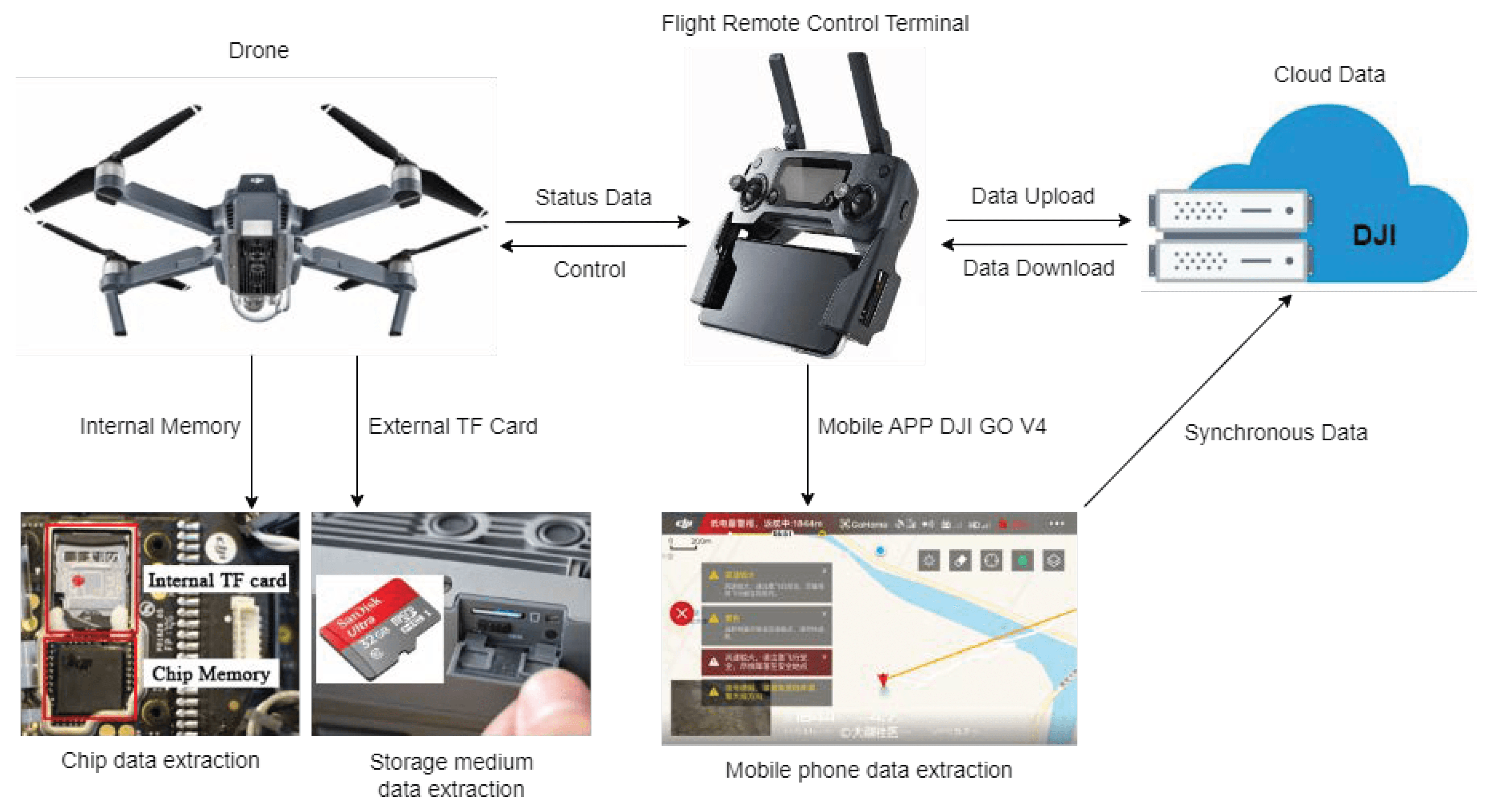
In addition to drones, their associated devices — controllers, cell phones, tablets, and computers — hold significant forensic value. These devices store command logs (records of instructions sent to the drone), mobile app data (log-in credentials, flight histories, and user profiles), and social media links (evidence of drone-related activities shared or coordinated online).
The controller and paired smartphone frequently contain more actionable intelligence than the drone itself — particularly for establishing operator identity, linking the drone to broader criminal networks, and recovering deleted mission files that were never stored on the UAV.
Table: Drone Evidence Sources by Component
| Component | Evidence Type | Forensic Value | Volatility |
|---|---|---|---|
| Flight controller | GPS path, motor logs, crash data | Highest | Low (flash storage) |
| Onboard camera/gimbal | Video, photos, GPS metadata | Very High | Medium |
| SD card | Media files, deleted content | High | Low |
| Battery management unit | Power cycles, charge history | Medium | Low |
| RF transceiver | Controller pairing, frequency logs | High | Very High |
| Paired smartphone | App data, credentials, social links | Very High | Medium |
Forensic Collection: Specialized Challenges and Methods
Physical Condition and Evidence Degradation
Unlike traditional mobile devices, drones are subject to extreme physical stress, proprietary encryption, and volatile data environments. Standard software-based extraction often fails when a drone is severely damaged or when the firmware is locked. To build a solid case, investigators need more than just a tool — they need a comprehensive methodological approach.
A crash-landed or deliberately destroyed drone presents specific acquisition challenges that have no parallel in mobile forensics. Carbon fiber frames survive crashes that completely destroy the storage media. Conversely, high-speed impacts can physically shatter NAND flash chips that appeared externally intact.
Evidence preservation sequence for recovered drones:
- Photograph in situ — document exact position, orientation, and condition before any interaction
- Identify all storage components — SD card, internal NAND flash, and controller memory separately
- Power assessment — never charge a damaged battery; document power state before any extraction
- Firmware identification — document exact firmware version before any extraction attempt
- Write-block all storage media — apply hardware write blockers to SD cards immediately
- Hash all acquired data — SHA-256 at collection and re-verify at every transfer
Specialized Tooling — DroneXtractor and Beyond
DroneXtractor is an open-source digital forensics suite written in Golang, designed specifically for DJI drones and focused on extracting and analyzing telemetry, sensor values, and flight data. The tool allows investigators to visualize flight paths, audit drone activity, and extract data from multiple file formats — enabling forensic reconstruction of complete flight histories.
Within digital forensics, drone forensics is a specialist profession that investigates and examines unmanned aerial vehicles for evidence. Drone forensics assists law enforcement, security organizations, and attorneys in finding solutions regarding drone abuse, mishaps, or security breaches — critical in locating infringers, evaluating privacy violations, and providing vital evidence in court cases.
Pro Tip: DJI drones store flight records in encrypted
.DATfiles on the internal storage — not on the SD card. These files require specialized decryption tools and contain the most complete flight telemetry record including data that is not visible in the DJI app's flight log. Always acquire internal storage separately from the SD card.
Counterintelligence and Battlefield Drone Forensics
Military and National Security Applications
In counterintelligence, captured drones provide valuable insights into adversaries' operations. Drones intercepted near sensitive installations often contain reconnaissance data. At Ramstein Air Base in Germany, forensic analysis of a captured drone suggested espionage activities. Controllers and connected devices store log-in credentials, communication logs, and metadata that can offer critical investigative leads.
Drone forensics is being redefined through integrating live, digital, and non-digital evidence acquisition systems — with the Korean government actively funding development of dedicated drone forensic analysis technology and investigative frameworks as of 2024.
Military drone forensics extends beyond criminal investigation into signals intelligence — analyzing RF fingerprinting, encryption schemes, and command-and-control infrastructure to attribute drones to specific nation-state or non-state operators.
Table: Drone Forensics by Investigation Type
| Investigation Type | Primary Evidence | Key Forensic Question |
|---|---|---|
| Criminal smuggling | GPS flight path, paired app data | Who operated it and from where? |
| Unauthorized surveillance | Camera footage, GPS waypoints | What was surveilled and when? |
| Counterintelligence | RF fingerprint, controller pairing | Which nation-state or group? |
| Corporate espionage | Video metadata, Wi-Fi probing logs | What data was captured? |
| Infrastructure attack | Flight path, payload data | What was the intended target? |
| Accident investigation | Motor logs, battery data, wind data | What caused the crash? |
Key Takeaways
- Acquire the controller and paired smartphone — these devices often contain more operator-identifying evidence than the drone itself
- Never charge a damaged drone battery — thermal runaway risk combined with evidence alteration makes this a dual safety and integrity failure
- Extract internal NAND storage separately from SD card — DJI
.DATflight records on internal storage are your most complete telemetry source - Apply write blockers to all storage media before any forensic interaction — drone SD cards are not treated differently from mobile storage
- Use DroneXtractor or equivalent for DJI telemetry extraction — generic mobile forensic tools miss encrypted
.DATflight records entirely - Document firmware version before extraction — firmware determines which extraction methods are available and which evidence formats to expect
Conclusion
Drone forensics in 2026 sits at the intersection of mobile forensics, IoT forensics, and signals intelligence — and it is one of the fastest-growing evidence domains across criminal, counterintelligence, and corporate investigations. The proliferation of commercial drones has made UAV evidence a routine element of criminal cases, while military and national security applications demand an even deeper forensic capability. Investigators who master drone-specific evidence sources, extraction methodology, and tooling — particularly the often-overlooked internal NAND storage and controller device analysis — will consistently recover evidence that standard mobile forensics workflows miss entirely. Begin building your drone forensics capability today. The next case that hinges on UAV evidence may already be in your queue.
Frequently Asked Questions
Q: What is drone forensics and what types of investigations require it? A: Drone forensics is the discipline of identifying, collecting, preserving, and analyzing digital evidence from unmanned aerial vehicles and their associated devices. It applies to criminal investigations involving smuggling, unauthorized surveillance, and corporate espionage; counterintelligence investigations of intercepted military drones; accident reconstruction; and any investigation where a UAV was used as a tool or was itself the subject of a security incident.
Q: What is the most important piece of evidence recoverable from a drone?
A: GPS telemetry logs — stored in the flight controller and, for DJI drones, in encrypted internal NAND .DAT files — provide the most forensically valuable evidence. They record the complete flight path, takeoff and landing coordinates, altitude, speed, and command inputs with second-level precision, establishing operator location and intent in ways that no other single evidence source can match.
Q: Can investigators access deleted files from a drone's SD card? A: Yes — SD cards from drones follow the same FAT32 or exFAT file system used in mobile devices, meaning deleted files can frequently be recovered using standard file carving techniques. Additionally, DJI drones maintain flight records in internal NAND storage that persists independently of SD card deletion, providing a separate recovery path for mission data.
Q: What is DroneXtractor and why is it significant for drone forensics?
A: DroneXtractor is an open-source forensic suite written in Golang specifically designed for DJI drone evidence extraction. It decrypts and parses the proprietary .DAT telemetry files stored in DJI internal NAND storage — files that contain the complete flight record but are not accessible to standard mobile forensic tools — enabling investigators to visualize complete flight paths and audit all drone activity.
Q: What legal frameworks govern drone evidence collection? A: Drone evidence collection intersects with aviation law (FAA regulations in the US, EASA in Europe), criminal procedure law governing device seizure and search, and privacy law (GDPR for footage captured in EU jurisdictions). NIST SP 800-101 Rev. 1 covers mobile device forensics applicable to paired controller devices. No universal drone-specific forensic standard exists as of 2026, though IEEE and ASTM working groups are developing guidance.

Enjoyed this article?
Subscribe for more cybersecurity insights.