
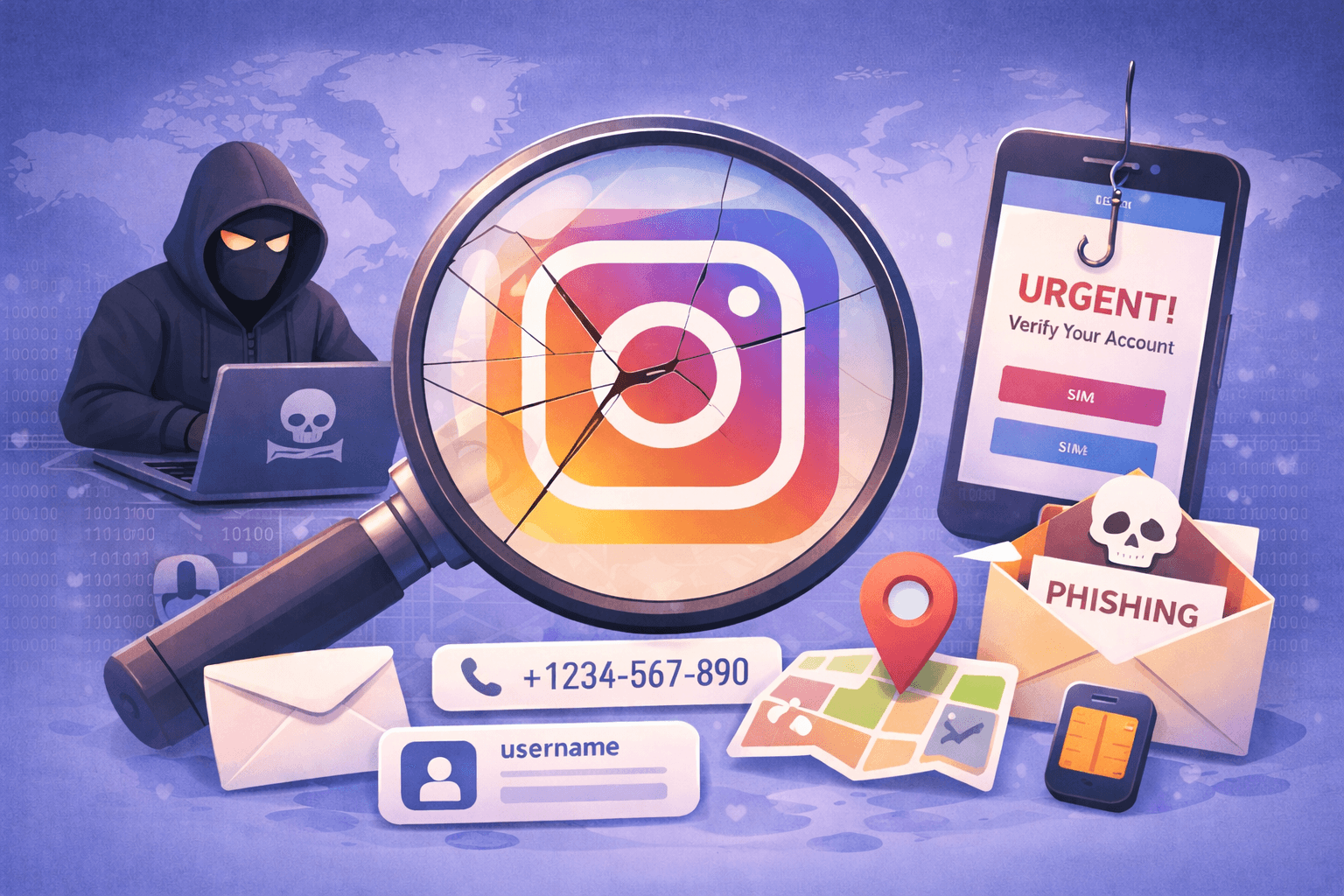
A dataset containing personal information linked to 17.5 million Instagram accounts has surfaced on dark web forums, marking another significant privacy breach for social media users. First discovered by Malwarebytes during routine dark web monitoring in early 2026, this exposure reveals a troubling reality: user data continues to flow into criminal marketplaces at an alarming scale.
The leaked information includes usernames, email addresses, phone numbers, and location data—a combination that transforms routine social media profiles into comprehensive dossiers for identity theft and account takeover. Security analysts report that attackers are already weaponizing this data, with affected users receiving suspicious password reset notifications and sophisticated phishing attempts designed to compromise their accounts.
This incident highlights critical vulnerabilities in how social platforms protect user information and underscores the urgent need for individuals to implement stronger security measures. Understanding what happened, how attackers exploit such leaks, and which defensive actions work best can mean the difference between maintaining control of your digital identity and becoming the next victim.
Understanding the Scope of the Instagram Data Breach
What Information Was Compromised
The exposed dataset contains four primary categories of personal information that collectively create significant security risks. Unlike simple username lists scraped from public profiles, this collection appears structured as API-style exports with deeper access to account details.
The compromised data includes:
- Usernames and profile identifiers that link accounts to specific individuals
- Email addresses used for account registration and recovery
- Phone numbers associated with two-factor authentication and account verification
- Location information tied to user profiles and posted content
- Profile metadata potentially including follower counts and engagement patterns
Table: Compromised Data Types and Associated Risks
| Data Type | Primary Risk | Secondary Risk | Exploitation Timeline |
|---|---|---|---|
| Email addresses | Phishing campaigns | Credential stuffing | Immediate (hours) |
| Phone numbers | SMS phishing (smishing) | SIM swap attacks | 24-48 hours |
| Usernames | Social engineering | Cross-platform tracking | Ongoing |
| Location data | Physical security threats | Targeted scams | Days to weeks |
How the Data Differs from Public Information
Security researchers emphasize that this leak extends beyond information visible on public Instagram profiles. The structured format suggests automated collection through application programming interfaces (APIs) rather than manual scraping of publicly displayed content.
This distinction matters because APIs can expose data fields that users never intended to share publicly. Even accounts set to private may have associated email addresses and phone numbers accessible through certain API endpoints, particularly those designed for legitimate business purposes like advertising platforms or analytics tools.
The dataset's organization indicates systematic extraction rather than opportunistic collection. Attackers likely exploited either deprecated API endpoints that Meta failed to properly secure, third-party services with excessive data access permissions, or automated tools designed to harvest information at scale before platform rate limits trigger.
Geographic and Demographic Distribution
While comprehensive geographic breakdowns remain unavailable pending Meta's official investigation, early analysis suggests the dataset includes users across multiple regions. Some security reports mention "country-specific sources," indicating attackers may have targeted particular markets or obtained data through region-locked API access.
The lack of clear demographic patterns suggests either broad-spectrum collection or aggregation from multiple smaller datasets. This uncertainty complicates notification efforts and leaves millions of users unsure whether their information appears in criminal marketplaces.
How Attackers Exploit Leaked Instagram Data
Account Takeover Techniques
Cybercriminals immediately began testing the leaked data for account access. Reports of legitimate Instagram password reset notifications surged shortly after the dataset appeared on BreachForums, indicating systematic attempts to compromise accounts using the exposed contact information.
Pro Tip: Unsolicited password reset emails don't always mean your password has been changed—they often indicate attackers are testing whether your email address is valid and actively monitored before launching more sophisticated attacks.
Attackers use several methods to convert leaked data into account access:
- Credential stuffing attacks that test email-password combinations leaked from other breaches against Instagram accounts
- Password reset exploitation using compromised email accounts or phone numbers to initiate legitimate recovery processes
- Social engineering against support teams armed with enough personal information to convincingly impersonate legitimate account holders
- SIM swap attacks that hijack phone numbers to intercept two-factor authentication codes sent via SMS
Multi-Channel Phishing Campaigns
The combination of email addresses and phone numbers enables attackers to launch coordinated campaigns across multiple communication channels simultaneously. Victims receive fraudulent security alerts via email, SMS text messages, and even Instagram direct messages—each designed to mimic official Meta communications.
These phishing attempts exploit psychological triggers including urgency ("Your account will be suspended"), authority (fake Meta security branding), and fear (threats of permanent data loss). Messages direct victims to convincing replica login pages that harvest credentials the moment users enter them.
Important: Meta never asks users to verify accounts by clicking links in unsolicited emails or text messages. All legitimate security communications direct users to access settings through the official Instagram app or website.
Identity Theft and Financial Fraud
Beyond account compromise, the leaked information enables broader identity theft schemes. Criminals combine Instagram data with information from other breaches to build comprehensive profiles for:
- Opening fraudulent credit accounts using stolen identities
- Filing false tax returns to claim refunds
- Applying for loans or government benefits
- Creating synthetic identities that blend real and fabricated information
Location data adds another dimension by enabling geographically targeted scams. Attackers reference local businesses, events, or landmarks to make fraudulent communications more convincing and increase victim trust.
The Technical Origin: API Misuse vs. Traditional Breach
Understanding API-Based Data Collection
The dataset's structure suggests collection through Instagram's application programming interfaces rather than a conventional network intrusion. APIs serve as communication channels that allow third-party applications, business tools, and developer platforms to interact with Instagram's core systems.
When properly secured, APIs expose only information necessary for legitimate functions—advertising analytics, business account management, or authorized third-party integrations. However, several scenarios can transform these legitimate interfaces into data leak vectors.
Table: Common API Vulnerability Scenarios
| Vulnerability Type | How It Works | Data Exposure Level | Detection Difficulty |
|---|---|---|---|
| Deprecated endpoints | Old API versions remain accessible after upgrades | High (full profile data) | Medium |
| Rate limit failures | Systems fail to restrict automated queries | Very high (mass collection) | Low |
| Third-party abuse | Legitimate apps exceed authorization scope | Variable (depends on permissions) | High |
| Authentication bypass | Weak tokens allow unauthorized access | Critical (unrestricted access) | Medium |
Historical Patterns in Social Media Data Leaks
This incident follows established patterns from previous large-scale Instagram data exposures. In 2024, a threat actor claimed possession of data from 489 million Instagram users, though verification remained incomplete. Another incident in early 2025 involved 17 million accounts with similar data fields—usernames, emails, phone numbers, and locations.
These recurring events suggest systemic challenges in securing social media platforms against mass data collection. The line between "data breach" (unauthorized access to protected systems) and "scraping" (automated collection of accessible information) remains legally and technically murky, complicating liability questions and user notification requirements.
Meta's Response and Information Gap
As of current reporting, Meta has not issued a comprehensive public statement explaining the dataset's origin, affected user segments, or remediation measures. This communication delay mirrors earlier incidents where social network data appeared on dark web forums without immediate platform acknowledgment.
The absence of official clarification creates uncertainty about whether users face risks from a platform vulnerability requiring technical fixes, an API misuse issue demanding policy changes, or third-party service compromise needing partnership reviews. Until Meta provides detailed forensic findings, security professionals recommend assuming potential exposure for all active Instagram users.
Immediate Security Actions for Instagram Users
Strengthening Account Authentication
Two-factor authentication (2FA) represents the most effective defense against account takeover, but implementation quality matters significantly. SMS-based 2FA—while better than nothing—remains vulnerable to SIM swap attacks where criminals hijack phone numbers by convincing mobile carriers to transfer service to attacker-controlled devices.
Implement these authentication improvements:
- Enable authenticator app-based 2FA using Google Authenticator, Authy, or similar applications that generate time-based codes independent of phone numbers
- Review authorized applications in Instagram settings and revoke access for unused or unfamiliar third-party services
- Create strong, unique passwords using password managers to generate and store complex credentials
- Remove phone numbers from public profile display to limit attacker reconnaissance opportunities
- Enable login alerts to receive notifications when accounts are accessed from new devices or locations
Monitoring for Exploitation Attempts
Early detection of compromise attempts provides critical opportunities to prevent successful attacks. Watch for these warning signs:
- Password reset emails you didn't request, especially multiple attempts within short timeframes
- Login notifications from unfamiliar locations or devices
- Followers reporting spam direct messages sent from your account
- Changes to profile information, posted content, or account settings you didn't make
- Unusual activity in linked email accounts suggesting attempts to access password reset messages
Table: Exploitation Warning Signs and Response Actions
| Warning Sign | Likely Attack Type | Immediate Action | Follow-Up |
|---|---|---|---|
| Unsolicited reset emails | Account testing | Verify email security | Change Instagram password |
| Unknown login attempts | Credential stuffing | Enable 2FA immediately | Check for password reuse |
| Spam from your account | Account compromise | Change password, revoke sessions | Scan for malware |
| Modified profile details | Successful takeover | Use account recovery | Contact Instagram support |
Email and Phone Number Security
Since the leaked dataset includes primary contact information, securing associated email accounts and phone services becomes equally important as protecting Instagram itself. Compromise of email accounts enables attackers to bypass Instagram security measures by intercepting password reset links.
Protect contact channels through:
- Enabling 2FA on all email accounts using authenticator apps rather than SMS
- Reviewing email forwarding rules to detect unauthorized redirection of messages
- Contacting mobile carriers to add PIN codes or passwords preventing unauthorized SIM card changes
- Monitoring credit reports for signs of identity theft attempts using exposed information
- Creating email aliases for social media accounts separate from primary addresses used for financial services
Long-Term Privacy Protection Strategies
Data Minimization Principles
The most effective defense against data leaks involves limiting what information platforms collect in the first place. Every data field you provide to Instagram represents potential exposure in future breaches or leaks.
Apply these minimization techniques:
- Remove phone numbers from Instagram profiles unless absolutely necessary for business verification
- Use secondary email addresses dedicated to social media rather than primary accounts linked to banking or professional services
- Disable location services in Instagram's mobile app settings except when actively posting location-tagged content
- Review privacy settings quarterly to ensure only intended audiences can access profile information
- Limit biographical information and avoid posting details like birthdates, addresses, or workplace specifics
Understanding Platform Data Practices
Instagram collects significantly more information than most users realize, even when profiles remain private. The platform tracks browsing behavior, engagement patterns, advertising interactions, and metadata from photos including location coordinates and device information.
Review Instagram's data download feature to understand what information the platform maintains. This export includes message history, search queries, IP addresses used to access your account, and advertising profiles built from your activity. Awareness of this collection scope helps inform decisions about continued platform use and appropriate privacy settings.
Alternative Platform Considerations
For users prioritizing privacy over social connectivity, alternative platforms with stronger privacy commitments exist. Services like Mastodon (decentralized social networking), Signal (encrypted messaging), or privacy-focused photo sharing platforms offer reduced data collection profiles.
However, these alternatives come with trade-offs including smaller user bases, reduced feature sets, and different security challenges. The decision to migrate platforms should balance privacy priorities against networking needs and acceptance that no online service offers absolute security guarantees.
Regulatory and Legal Implications
Data Protection Compliance Questions
This incident raises complex questions about Meta's compliance with global data protection regulations including the European Union's General Data Protection Regulation (GDPR), California Consumer Privacy Act (CCPA), and similar frameworks worldwide.
GDPR requires companies to implement "appropriate technical and organizational measures" to protect personal data and mandates notification of supervisory authorities within 72 hours of discovering breaches. If Meta determines the data originated from platform vulnerabilities rather than simple scraping, significant regulatory scrutiny and potential fines may follow.
The legal distinction between "data breach" and "data scraping" affects notification obligations and liability. Companies often argue that automated collection of publicly accessible information doesn't constitute a breach requiring user notification, though this position faces increasing regulatory challenge as collection scales reach hundreds of millions of users.
Corporate Accountability and Transparency
Meta's delayed response mirrors industry patterns where platforms minimize public communication about data exposures until complete forensic investigations finish. While thorough investigation serves legitimate purposes, this approach leaves affected users in extended uncertainty about risks and appropriate protective actions.
Security professionals advocate for interim communications that acknowledge incidents, provide preliminary guidance, and commit to updates as investigations progress. This balanced approach respects both investigative integrity and user needs for timely risk information.
Individual Legal Recourse Options
Affected users have limited but potentially viable legal options depending on jurisdiction and final determination of the incident's cause. Class action lawsuits following major data breaches typically argue platforms failed to implement reasonable security measures or adequately protect user information as promised in terms of service.
However, social media platforms generally include liability limitations and arbitration clauses in user agreements that complicate legal action. Successful claims usually require demonstrating actual harm—identity theft, financial losses, or quantifiable damages—rather than theoretical privacy violations alone.
Industry-Wide Lessons and Future Outlook
The Evolution of Social Media Threats
Large-scale data exposures have evolved from relatively rare events to recurring incidents affecting hundreds of millions of users across platforms. This shift reflects both improved attacker capabilities and the inherent challenges of securing platforms designed to share information while simultaneously protecting privacy.
Modern threat actors combine technical skills, persistence, and marketplace knowledge to monetize user data efficiently. The ecosystem includes data collectors who harvest information, brokers who aggregate and verify datasets, and end users who leverage exposed data for fraud, account takeover, or targeted attacks.
Platform Security Architecture Challenges
Instagram faces architectural tensions between business models requiring data collection for advertising and user expectations of privacy protection. APIs enabling business partnerships and developer ecosystems create necessary but potentially vulnerable access points to user information.
Balancing these competing priorities requires continuous security investment including:
- Regular API security audits identifying deprecated or overly permissive endpoints
- Automated monitoring detecting unusual data access patterns suggesting bulk collection
- Rate limiting preventing mass automated queries while allowing legitimate usage
- Third-party application vetting ensuring partner services respect data access restrictions
- User transparency enabling informed decisions about data sharing with connected services
Building Personal Cyber Resilience
Individual users cannot control platform security decisions but can build resilience reducing impact when breaches inevitably occur. This resilience emerges from layered defenses, situational awareness, and rapid response capabilities.
Think of cybersecurity like physical health—no single action guarantees safety, but combinations of good practices significantly reduce risk. Just as wearing seatbelts, maintaining vehicles, and driving defensively work together to prevent traffic injuries, implementing strong authentication, minimizing data exposure, and monitoring for threats combine to protect digital identities.
Key Takeaways
- Enable authenticator app-based two-factor authentication on Instagram and associated email accounts immediately—SMS-based 2FA alone remains vulnerable to SIM swap attacks
- Monitor for exploitation attempts including unsolicited password reset emails, unfamiliar login notifications, and suspicious account activity indicating compromise testing
- Minimize data exposure by removing phone numbers from public profiles, using secondary email addresses for social media, and disabling unnecessary location services
- Assume potential exposure until Meta provides comprehensive incident details—implement protective measures even without confirmation your specific account appears in the leaked dataset
- Understand that API-based data collection blurs traditional breach definitions and may delay or prevent formal notification despite significant privacy implications
- Build layered defenses recognizing that no single security measure provides complete protection against determined attackers with access to comprehensive personal information
Conclusion
The exposure of 17.5 million Instagram users' personal information represents more than an isolated security incident—it exemplifies ongoing challenges securing social platforms against data harvesting at scale. The combination of usernames, email addresses, phone numbers, and location data creates comprehensive profiles that attackers are already weaponizing for account takeover, phishing campaigns, and identity theft.
While Meta's investigation continues and technical details remain uncertain, the immediate reality demands action from affected users. Strong authentication, contact information security, and vigilant monitoring for exploitation attempts provide practical defenses against the most common attack vectors enabled by this leak.
Looking forward, expect data exposures to remain recurring features of social media participation. Building personal cyber resilience through informed platform choices, aggressive data minimization, and layered security measures represents the most realistic path to maintaining digital privacy in an ecosystem where perfect security remains elusive. Take action now to strengthen your Instagram account security—the criminals trading this data certainly won't wait.
Frequently Asked Questions
Q: How do I know if my Instagram account data was included in this leak?
A: Meta has not yet provided tools to check specific account exposure, so assume potential risk if you have an active Instagram account. Monitor for warning signs including unsolicited password reset emails, unfamiliar login attempts, or suspicious activity. Enable strong two-factor authentication regardless of confirmed exposure status.
Q: Is changing my Instagram password enough to protect my account after this leak?
A: Password changes alone provide limited protection since the leak includes email addresses and phone numbers attackers can use for account recovery or phishing. You must also enable authenticator app-based two-factor authentication, secure associated email accounts, and monitor for exploitation attempts across all linked services.
Q: Can I sue Instagram or Meta for this data exposure?
A: Legal options depend on your jurisdiction and the incident's final classification as a breach versus scraping. Most social media terms of service include liability limitations and arbitration requirements. Successful claims typically require demonstrating actual damages like identity theft or financial losses rather than privacy concerns alone.
Q: Should I delete my Instagram account to prevent future data leaks?
A: Account deletion removes future exposure risk but won't retrieve data already leaked. Consider whether Instagram's value justifies ongoing privacy risks given recurring incidents. If maintaining your account, implement maximum security settings, minimize stored personal information, and use privacy-focused configurations limiting data collection.
Q: What's the difference between a data breach and data scraping, and why does it matter?
A: Data breaches involve unauthorized access to protected systems, while scraping automates collection of accessible information through legitimate interfaces like APIs. This distinction affects company notification obligations, regulatory consequences, and legal liability. However, from a user security perspective, both scenarios expose personal information to criminals regardless of technical classification.

Enjoyed this article?
Subscribe for more cybersecurity insights.