
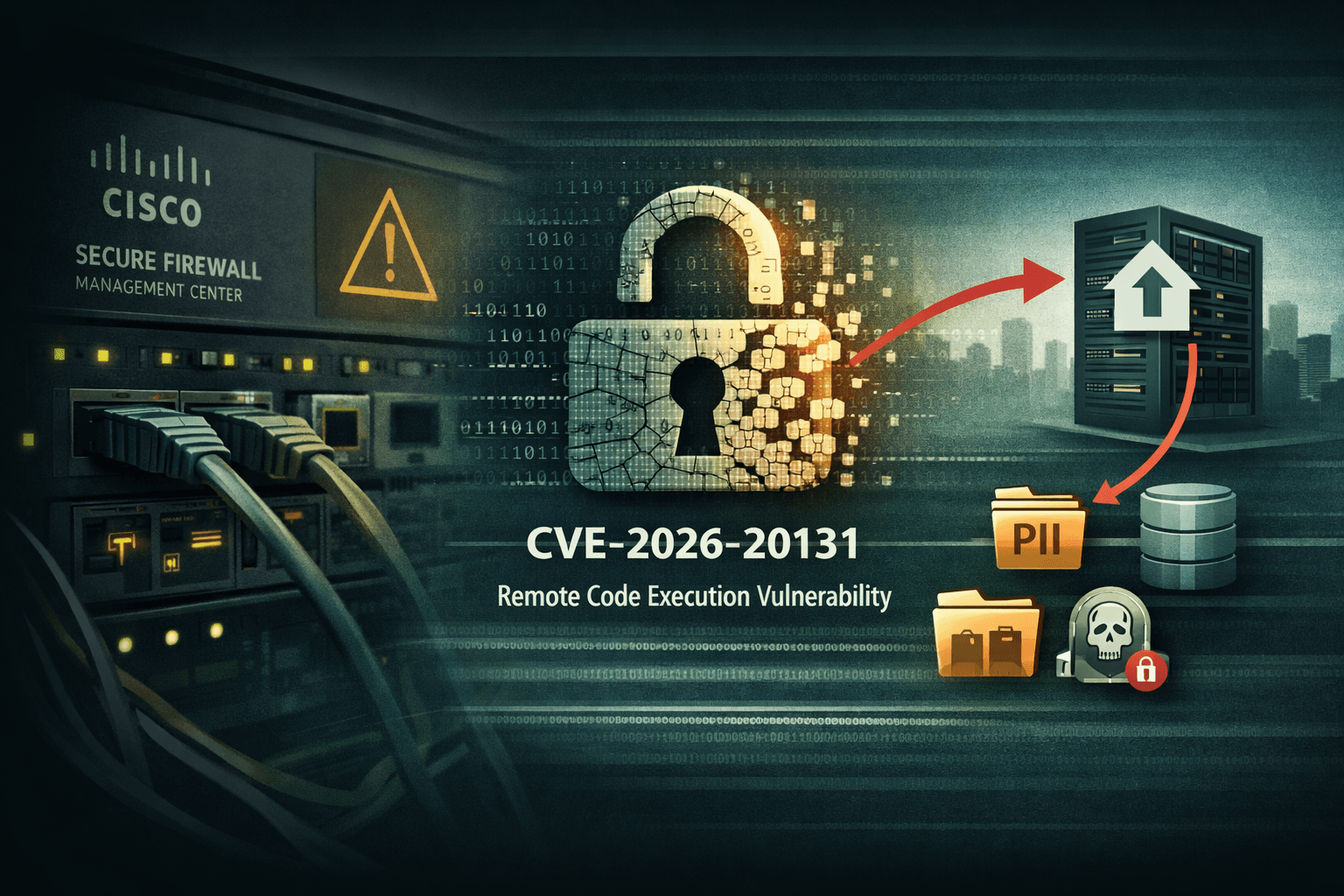
A critical vulnerability in enterprise firewall infrastructure is actively under attack — and organizations may have already been breached before they even knew the flaw existed. CVE-2026-20131, a CVSS 10.0 zero-day in Cisco Secure Firewall Management Center (FMC), is being weaponized by the Interlock ransomware group through an insecure deserialization bug in the FMC web interface. This vulnerability allows unauthenticated remote code execution (RCE) as root, granting attackers the highest possible level of system access without any valid credentials.
Exploitation began on January 26, 2026 — more than a month before public disclosure — according to joint observations by Amazon Threat Intelligence and Cisco. That timeline confirms real-world zero-day abuse against enterprise firewalls at scale. If your organization runs Cisco Secure FMC with internet-exposed management interfaces, you are in the crosshairs. This post breaks down exactly how the exploit chain works, what Interlock does after gaining access, and what you must do right now to protect your environment.
Understanding CVE-2026-20131: The Vulnerability Mechanics
CVE-2026-20131 is an insecure deserialization vulnerability residing in the web interface of Cisco Secure Firewall Management Center. Deserialization flaws occur when an application processes attacker-controlled serialized data without proper validation, enabling code injection at the parsing stage.
How the Exploit Chain Works
The attack begins when threat actors send crafted HTTP requests containing malicious serialized Java objects to a specific FMC web interface path. No authentication is required. The FMC deserializes the payload, executing embedded Java code with root-level privileges — bypassing every access control downstream.
The exploit uses a two-URL methodology observed in the wild:
- URL 1 fetches attacker-controlled configuration data to stage the exploit payload
- URL 2 confirms successful exploitation by forcing the compromised device to upload a generated file via HTTP PUT to an attacker-controlled server
This bidirectional confirmation technique helps threat actors validate successful compromise before investing further resources in post-exploitation activity.
Why CVSS 10.0 Matters for Enterprise Security
A CVSS (Common Vulnerability Scoring System) score of 10.0 represents the maximum possible severity. This rating reflects the combination of factors that make CVE-2026-20131 uniquely dangerous.
Table: CVE-2026-20131 CVSS v3.1 Breakdown
| Metric | Value | Implication |
|---|---|---|
| Attack Vector | Network | Remotely exploitable |
| Attack Complexity | Low | No specialized conditions required |
| Privileges Required | None | No authentication needed |
| User Interaction | None | Fully automated exploitation possible |
| Scope | Changed | Impact extends beyond FMC itself |
| Confidentiality / Integrity / Availability | High / High / High | Total system compromise |
The combination of network-accessible, unauthenticated, zero-interaction exploitation is what places this vulnerability in the most dangerous tier of enterprise threats.
Interlock's Post-Exploitation Playbook
Once Interlock achieves root-level access to the FMC, operators execute a methodical multi-stage attack designed to maximize both data exfiltration value and ransomware impact before triggering encryption.
Initial Reconnaissance and Network Mapping
Interlock deploys PowerShell scripts immediately after gaining access to build a comprehensive picture of the victim environment. These scripts harvest system information, enumerate user accounts, collect browser-stored credentials, and map accessible network segments. The group prioritizes identifying high-value assets — backup infrastructure, domain controllers, and data repositories — before any destructive activity begins.
This reconnaissance phase mirrors tactics catalogued in the MITRE ATT&CK framework under Discovery (TA0007), specifically System Information Discovery (T1082) and Network Service Discovery (T1046).
Custom RAT Deployment for Persistence
What distinguishes Interlock's operation from commodity ransomware is the deployment of custom Remote Access Trojans (RATs). Researchers have observed both Java-based and JavaScript-based RAT variants used in this campaign.
These RATs provide:
- Persistent backdoor access surviving reboots and partial remediation
- Command execution capabilities for issuing follow-on instructions
- Bidirectional file transfer for staging tools and exfiltrating data
- Encrypted command-and-control (C2) channels to evade network inspection
Important: Standard endpoint detection tools may not flag these custom RATs, as they lack known malware signatures. Behavioral detection and network anomaly monitoring are essential in identifying this activity.
Data Exfiltration Before Ransomware Deployment
Interlock follows a double-extortion model. Sensitive data — including personally identifiable information (PII), financial records, and intellectual property — is encrypted and exfiltrated via the RAT's encrypted channels before ransomware payload detonation. Organizations that refuse to pay face both encrypted systems and threatened public data release.
This approach increases pressure on victims and creates compliance implications under regulations including GDPR, HIPAA, and PCI DSS, where data breach notification obligations begin the moment exfiltration occurs — not when ransomware detonates.
Threat Timeline and Attribution Context
Understanding the timeline of this campaign is critical for incident response teams assessing potential exposure windows.
Table: CVE-2026-20131 Campaign Timeline
| Date | Event |
|---|---|
| January 26, 2026 | First observed exploitation in the wild (Amazon Threat Intelligence / Cisco) |
| Late February 2026 | Pattern of exploitation confirmed across multiple enterprise targets |
| March 2026 | Public disclosure and CVE assignment |
| March 2026 | Cisco patch release |
The 30+ day gap between first exploitation and public disclosure represents a significant blind spot. Organizations that rely solely on patch Tuesday cycles or public CVE feeds for vulnerability prioritization had no actionable intelligence during the period of peak initial compromise.
Pro Tip: Subscribing to threat intelligence feeds from vendors with active sensor networks — not just public CVE databases — provides earlier warning for zero-day exploitation activity.
Detection, Hunting, and Immediate Response
With confirmed exploitation beginning weeks before public disclosure, the priority for security teams is determining whether compromise already occurred, not just preventing future attacks.
Indicators to Hunt in Your Environment
Security teams running Cisco Secure FMC should immediately begin threat hunting for the following:
- Anomalous HTTP POST or PUT requests to FMC management interface paths, particularly those containing serialized Java object patterns (identified by
ac ed 00 05magic bytes in hex) - Unexpected outbound HTTP PUT requests from FMC to external IP addresses
- Root-level process execution originating from web server processes on FMC
- New or modified files in system directories not consistent with legitimate FMC operations
- Unusual PowerShell execution from FMC host or adjacent management systems
Log Sources and Detection Priorities
Table: Detection Sources for CVE-2026-20131 Activity
| Log Source | What to Look For | Priority |
|---|---|---|
| FMC Web Server Logs | POST requests to deserialization endpoint | Critical |
| Network Perimeter Logs | Outbound HTTP PUT to unknown external IPs | Critical |
| Endpoint/EDR on FMC Host | Root-level shell spawning from web processes | Critical |
| DNS Logs | Anomalous C2 beacon patterns from management network | High |
| SIEM Correlation | PowerShell from management tier to internal hosts | High |
Immediate Remediation Steps
- Apply the Cisco patch for CVE-2026-20131 immediately — treat this as an emergency change outside normal change management windows
- Restrict internet exposure of FMC management interfaces — management plane access should never be internet-routable
- Review firewall rules governing access to FMC on ports 443 and 8305 and restrict to named management IP ranges
- Isolate FMC from production network segments if compromise indicators are found pending forensic investigation
- Audit root-level activity on the FMC host for the period from January 26, 2026 onward
- Notify your incident response team or retainer immediately if indicators of compromise are confirmed
Security Architecture Lessons for Enterprise Firewall Management
This attack highlights a systemic architectural weakness: management plane exposure. Many organizations expose firewall management interfaces directly to the internet or to poorly segmented internal networks — configurations that convert a software vulnerability into an immediate full-compromise scenario.
Management Plane Segmentation
The CIS Controls v8 (Control 12: Network Infrastructure Management) and NIST SP 800-41 both mandate strict separation of management traffic from production traffic. Management interfaces for security appliances — firewalls, IDS/IPS, and FMC — should only be accessible from dedicated out-of-band management networks with strict source IP filtering and multi-factor authentication (MFA).
Defense-in-Depth Against Zero-Day Exploitation
No single control prevents zero-day exploitation. Effective defense combines multiple layers.
Table: Defense-in-Depth Controls Against Zero-Day FMC Exploitation
| Control Layer | Implementation | Maps To |
|---|---|---|
| Network Segmentation | Restrict FMC to OOB management VLAN | CIS Control 12 |
| Access Control | MFA + IP allowlisting for FMC access | CIS Control 6 |
| Detection | Behavioral SIEM rules on management tier | CIS Control 8 |
| Threat Intelligence | Subscribe to vendor-direct threat feeds | NIST CSF DE.AE |
| Incident Response | IR plan with pre-authorized emergency patching | NIST CSF RS |
| Backup Integrity | Offline / immutable backups tested regularly | ISO 27001 A.12.3 |
Applying these controls does not eliminate zero-day risk — but it dramatically reduces the blast radius when exploitation occurs.
Key Takeaways
- Patch Cisco Secure FMC immediately — CVE-2026-20131 is a CVSS 10.0 actively exploited zero-day enabling unauthenticated root RCE
- Hunt for compromise from January 26, 2026 onward — exploitation predated public disclosure by over a month
- Restrict FMC management interface exposure — internet-accessible management planes convert vulnerabilities into immediate full compromise
- Deploy behavioral detection on management tier — signature-based tools will not catch Interlock's custom Java and JavaScript RATs
- Treat data exfiltration as the primary incident trigger — Interlock exfiltrates before encrypting, meaning breach notification obligations may already apply
- Review your zero-day response playbook — patch-on-disclosure cycles are insufficient when exploitation begins weeks before CVE assignment
Conclusion
CVE-2026-20131 represents exactly the threat model that security architects have long warned about: a CVSS 10.0 unauthenticated RCE in a security control platform, exploited by a sophisticated ransomware group before defenders had any public signal to act on. Interlock's combination of zero-day access, custom RAT deployment, data exfiltration, and ransomware detonation creates a multi-dimensional incident that tests every layer of an organization's security program simultaneously.
The organizations best positioned to survive this campaign are those that already restricted management interface exposure, maintained behavioral detection on their management tier, and had tested incident response plans ready to execute. If your organization has not reached that posture yet, the path forward starts with patching CVE-2026-20131 today, scoping your FMC access controls this week, and using this campaign as the forcing function to mature your management plane security architecture.
Frequently Asked Questions
Q: What versions of Cisco Secure FMC are affected by CVE-2026-20131? A: Cisco has published an advisory identifying affected FMC software versions — you should consult the official Cisco Security Advisory for CVE-2026-20131 directly at Cisco's security portal for the definitive version list and patch availability. Apply the patch immediately regardless of version, as exploitation is confirmed in the wild.
Q: How can I tell if my FMC was compromised before the patch was available? A: Review FMC web server logs for anomalous POST and PUT requests to management interface paths, especially from January 26, 2026 onward. Look for unexpected outbound HTTP PUT requests to external IPs and any root-level process execution spawning from web server processes. If indicators are found, engage an incident response team before attempting remediation, as Interlock deploys persistent RATs that survive simple patching.
Q: Does applying the Cisco patch remove an existing Interlock RAT infection? A: No. Patching closes the initial access vector but does not remove malware already deployed on compromised systems. If exploitation occurred before patching, the FMC host and any systems the threat actor pivoted to must be forensically investigated and remediated separately. Patching alone on a compromised system provides a false sense of security.
Q: Does this attack trigger GDPR or HIPAA breach notification obligations? A: Potentially yes — Interlock exfiltrates data before deploying ransomware, and both GDPR and HIPAA treat confirmed or reasonably suspected unauthorized access to personal or protected health data as a notifiable breach event, regardless of whether ransomware encrypted the data afterward. Organizations should engage legal counsel and their data protection officer immediately upon confirming compromise.
Q: What is the best long-term architectural control to prevent this class of attack? A: Strict management plane segmentation is the highest-impact architectural control. FMC and all security appliance management interfaces should only be accessible from dedicated out-of-band management networks with source IP allowlisting and MFA enforced. This configuration means that even a CVSS 10.0 unauthenticated vulnerability cannot be exploited remotely by an external threat actor, since the management interface is never routable from untrusted networks.

Enjoyed this article?
Subscribe for more cybersecurity insights.