
IoT Botnets Hit 30 Tbps: Inside the DoJ's Global DDoS Takedown
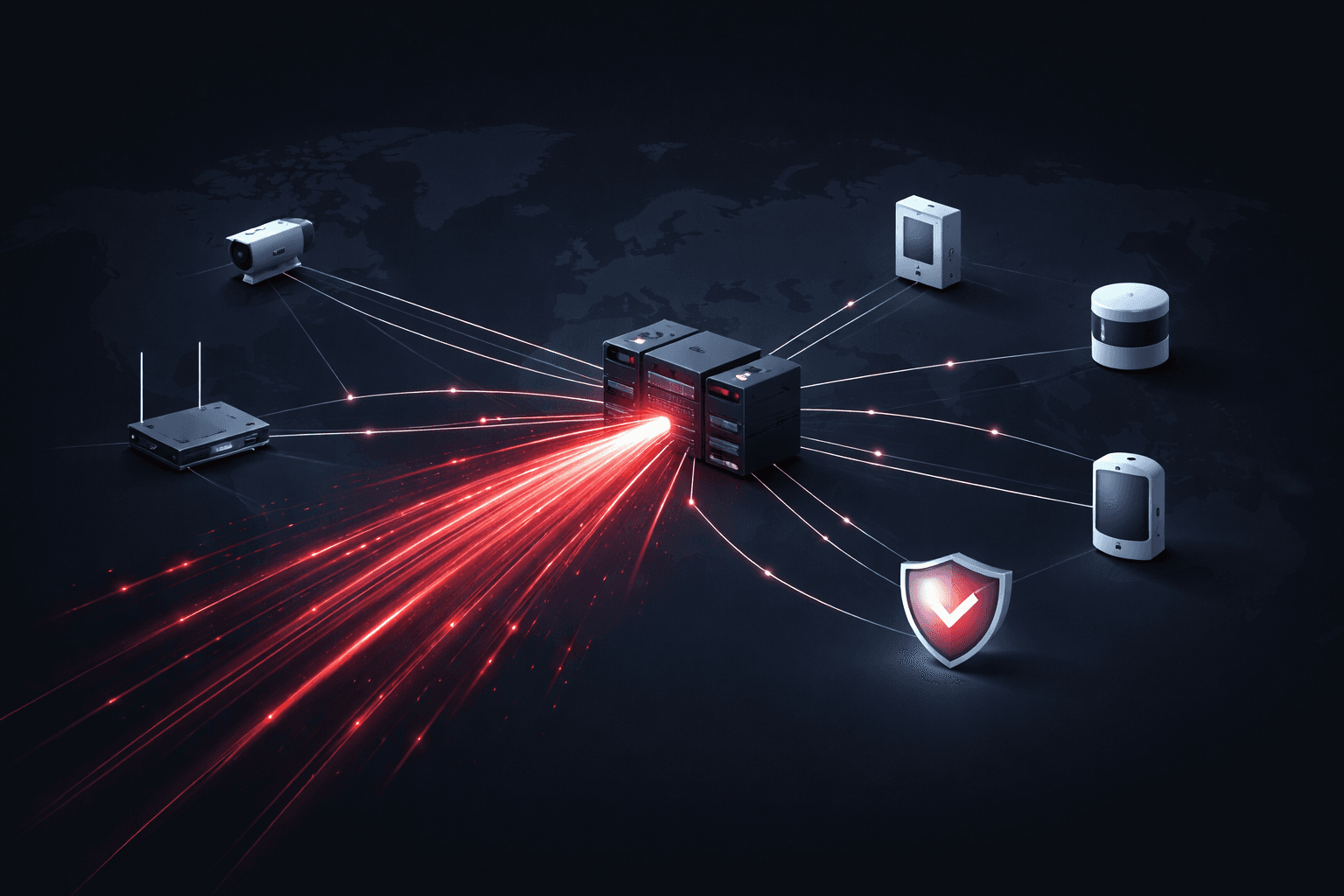
In early 2025, the U.S. Department of Justice disrupted four IoT botnets that had collectively hijacked approximately 3 million devices and were capable of launching DDoS attacks peaking at 30–31.4 Tbps — with burst rates around 14 billion packets per second. To put that in context, that is enough traffic to overwhelm virtually every ISP backbone in a mid-sized country simultaneously. These were not nuisance-level attacks. They were extortion instruments, used to threaten service providers, financial institutions, and critical infrastructure operators with sustained outages unless ransom was paid.
This post breaks down how these botnets operated, what the DoJ takedown actually accomplished, and what defenders and network operators need to do differently in IoT-heavy environments. The technical evidence that supported the operation — malware samples, decrypted C2 configurations, attack telemetry — came from XLab and Akamai, underscoring how private-sector threat intelligence sharing now sits at the center of law enforcement operations.
How 3 Million IoT Devices Became a 30 Tbps Weapon
The scale here is worth unpacking. A 30 Tbps DDoS capability does not emerge from sophisticated zero-days. It emerges from years of neglect across millions of consumer and small-business IoT devices — routers, DVRs, IP cameras, NAS devices — that ship with default credentials, receive no firmware updates after sale, and sit on home and small business networks with no network segmentation between them and everything else.
The Recruitment Chain
Botnet recruitment across these four operations followed a pattern consistent with Mirai-family malware lineages (MITRE ATT&CK T1190 — Exploit Public-Facing Application, T1078.001 — Default Accounts):
- Internet-wide scanning for devices with open Telnet, SSH, or management interfaces
- Credential stuffing against default username/password combinations (
admin/admin,root/1234, and manufacturer-specific defaults) - Deployment of a dropper that pulls architecture-appropriate binaries for MIPS, ARM, x86 variants
- Persistence via cron jobs or init scripts; watchdog processes that respawn the bot if killed
- C2 registration over TCP or UDP using custom binary protocols — in several cases, the C2 configs were encrypted, which is why Akamai's decryption capability was operationally critical
Important: The bottleneck for IoT botnet scale is not exploitation sophistication — it is the sheer number of reachable, unpatched devices. Shodan currently indexes over 15 billion exposed devices. Reducing that attack surface requires manufacturer accountability, not just end-user patching.
The Attack Capability
These botnets were classified as "hyper-volumetric" because they combined high bit-rate flooding with high packet-rate attacks. The ~14 billion packets-per-second peak matters separately from the 30 Tbps figure: packet-rate attacks exhaust the forwarding capacity of routers and stateful firewalls even when raw bandwidth is available to absorb them. This dual-vector approach (T1498 — Network Denial of Service) is specifically designed to defeat single-layer DDoS mitigation.
| Attack Vector | Impact Mechanism | Detection Signal |
|---|---|---|
| UDP flood | Bandwidth saturation at upstream providers | Traffic volume anomaly on border interfaces |
| TCP SYN flood | State table exhaustion on firewalls/load balancers | SYN-to-ACK ratio drop in flow telemetry |
| Packet-rate flood | Forwarding engine overload on routers | PPS counter spikes in SNMP/IPFIX data |
| Amplification (DNS/NTP) | Traffic multiplication via open resolvers | Asymmetric source traffic from known amplifiers |
The Extortion Model: DDoS as a Business Operation
These botnets were not operated by individual actors pursuing notoriety. They ran as commercial DDoS-for-hire services with an extortion component layered on top. Operators would threaten a target organization — often in gaming, hosting, finance, or media — with a sustained attack unless payment was made. Simultaneously, DDoS-for-hire customers could rent attack capacity against their own targets.
This dual revenue model mirrors what we saw with the Ghost npm campaign's affiliate structure: criminal infrastructure increasingly separates the technical operators from the end customers, creating resilient business models that survive individual arrests.
Pro Tip: If your organization receives a DDoS extortion threat, report it to the FBI IC3 immediately and do not pay. Payment does not guarantee the attack stops, and it funds the next extortion campaign. Engage your upstream ISP and DDoS mitigation provider before any deadline passes — most extortion windows are deliberately short to prevent defenders from reacting.
Organizations operating under PCI DSS Requirement 6.4 (protection against web-based attacks) and SOC 2 Availability criteria should document their DDoS response procedures explicitly, as regulators increasingly expect demonstrated DDoS resilience for internet-facing services.
How the DoJ Takedown Actually Worked
Traditional law enforcement botnet takedowns seize domains and arrest operators. This operation went further by seizing and redirecting C2 infrastructure — effectively cutting off the bots' ability to receive attack commands or check in with their operators. This is operationally significant because the infected devices themselves remain compromised; what changes is whether those devices can be commanded.
The Role of Private Sector Intelligence
XLab and Akamai's contributions were not peripheral to this operation. They were central to it:
- Malware sample analysis: Identifying the specific bot families and their C2 communication protocols
- C2 decryption: Several botnet families used encrypted C2 configs to resist analysis; breaking this encryption revealed active infrastructure addresses
- Attack evidence: Documented attack traffic from botnet nodes provided the evidentiary basis for legal action in multiple jurisdictions
This model aligns directly with NIST SP 800-61 (Computer Security Incident Handling) recommendations for coordinated public-private incident response and the CISA-FBI joint advisory framework for botnet disruption.
| Takedown Action | Operational Effect | Limitation |
|---|---|---|
| C2 domain seizure | Bots cannot receive new commands | Bots remain infected on endpoint devices |
| C2 sinkholing | Attack traffic redirected to law enforcement servers | Requires ongoing sinkhole maintenance |
| Infrastructure hosting takedown | Eliminates backup C2 nodes | Actors rebuild on bulletproof hosting |
| Criminal charges / arrests | Deterrence; disrupts operational leadership | Limited jurisdiction for overseas actors |
What "Significantly Reduced Capacity" Means in Practice
Post-takedown assessments from Akamai indicated meaningful reductions in active DDoS capacity from the targeted botnet clusters. However, "significantly reduced" does not mean "eliminated." The infected devices are still compromised. Actors with access to the malware source code can rebuild C2 infrastructure. The practical window created by a takedown — where defenders can reclaim network capacity and infected device owners can be notified — is measured in weeks, not permanently.
What Network Defenders and IoT Operators Need to Do Now
Does your organization know how many IoT devices are on your network right now? If your answer involves uncertainty, you have a discovery problem before you have a security problem.
Network-Level Defenses
Implementing CIS Control 13 (Network Monitoring and Defense) and CIS Control 1 (Inventory and Control of Enterprise Assets) forms the baseline:
- Maintain a complete asset inventory that includes IoT/OT devices, not just servers and workstations
- Segment IoT devices onto isolated VLANs with no lateral movement path to enterprise systems (ISO 27001 A.13.1.3)
- Deploy NetFlow or IPFIX collection on all border interfaces; establish baseline traffic profiles so volumetric anomalies generate alerts within minutes, not hours
- Block outbound traffic from IoT VLANs to known C2 infrastructure using threat intelligence feeds (MITRE ATT&CK T1071 mitigation)
- Configure rate limiting and traffic shaping at the ISP or CDN layer — on-premises DDoS mitigation alone cannot absorb 30 Tbps
IoT Device Hardening
| Hardening Control | Addresses | Priority |
|---|---|---|
| Change default credentials on deployment | T1078.001 Default Accounts | Critical |
| Disable unused services (Telnet, UPnP, remote management) | T1190 Exposed Services | Critical |
| Enable automatic firmware updates where available | CVE-based exploitation | High |
| Implement certificate-based authentication for management interfaces | Credential attacks | High |
| Network access control (802.1X or MAC-based) on IoT VLANs | Unauthorized device enrollment | Medium |
Key Takeaways
- Audit your IoT device inventory this week — if you cannot enumerate every device on your network, you cannot defend it.
- Implement ISP-layer or cloud-based DDoS scrubbing before you need it; on-boarding during an attack adds hours of exposure.
- Block Telnet (TCP 23) outbound from all internal networks — there is no legitimate reason for an IoT device to initiate Telnet connections externally.
- Share threat intelligence with law enforcement proactively — the DoJ takedown succeeded in part because Akamai and XLab had already characterized these botnets; your incident data has value beyond your own response.
- Document DDoS response procedures explicitly for compliance purposes (PCI DSS, SOC 2 Availability) and test them annually.
- Treat C2 takedowns as temporary windows, not permanent fixes — rotate blocklists and verify infected devices in your IP ranges receive remediation notifications from ISPs.
Conclusion
The disruption of these four botnets is a meaningful operational success, but it does not change the underlying conditions that made 3 million hijacked devices possible. Consumer and small-business IoT devices will continue shipping with default credentials, minimal update mechanisms, and no network isolation. The attack surface these devices represent is growing faster than remediation efforts can shrink it.
For defenders, the actionable insight is narrow but important: you cannot control what manufacturers ship or what your employees plug in at home, but you can control visibility and segmentation on your own networks. That means complete asset discovery, ISP-layer DDoS mitigation agreements signed before an attack occurs, and active participation in threat intelligence sharing frameworks. Start with your network edge — run a full IoT asset audit this week and identify every device that still has factory-default credentials.
Frequently Asked Questions
How do I know if devices on my network are part of a botnet? Look for outbound connections to unusual IP ranges, especially on non-standard ports, from devices that have no business reason to initiate outbound traffic (cameras, printers, smart TVs). NetFlow data showing persistent low-volume beaconing at regular intervals is a classic C2 check-in pattern. Compare your outbound traffic against threat intelligence feeds — both Akamai and XLab publish indicators from their botnet research. Your SIEM should have rules for T1071 (Application Layer Protocol for C2).
Can my organization's firewall absorb a 30 Tbps attack? No on-premises hardware can. A 30 Tbps attack saturates upstream transit links before traffic reaches your firewall. Effective DDoS defense at this scale requires upstream scrubbing — either through your ISP's mitigation service or a cloud-based DDoS mitigation provider like Akamai Prolexic, Cloudflare Magic Transit, or AWS Shield Advanced. These services absorb traffic at their own network edge before it reaches your infrastructure.
What is the difference between a DDoS takedown and actually fixing the problem? A C2 takedown severs the command channel between the attacker and the infected devices. It reduces the attacker's ability to direct attacks but does not remove the malware from the 3 million compromised devices. Those devices remain vulnerable to re-infection by the same or different actors. The underlying problem — unpatched, default-credential IoT devices on public IP addresses — persists until device owners remediate or ISPs implement customer notification programs.
Should smaller organizations worry about hyper-volumetric DDoS? Direct targeting at 30 Tbps levels is unlikely for most small organizations, but collateral damage is real — shared hosting providers, ISPs, and CDN nodes that are targets can cause downstream service disruptions for customers who share infrastructure. The more relevant risk for most organizations is targeted extortion attacks in the 100 Gbps–1 Tbps range, which are accessible via DDoS-for-hire services for a few hundred dollars and can fully disrupt unprotected internet-facing services.
How does the DoJ coordinate multi-jurisdictional botnet takedowns? These operations typically run through the FBI Cyber Division in coordination with EUROPOL's European Cybercrime Centre (EC3) and national CERTs in affected countries. The legal instruments used — seizure warrants, mutual legal assistance treaties (MLATs), and court-authorized domain redirects — vary by jurisdiction. Private sector partners like Akamai and XLab provide technical evidence and infrastructure mapping that gives law enforcement actionable targets across multiple hosting providers simultaneously. The FBI's Internet Crime Complaint Center (IC3) is the primary reporting channel for U.S. organizations contributing incident data to these operations.

Enjoyed this article?
Subscribe for more cybersecurity insights.