
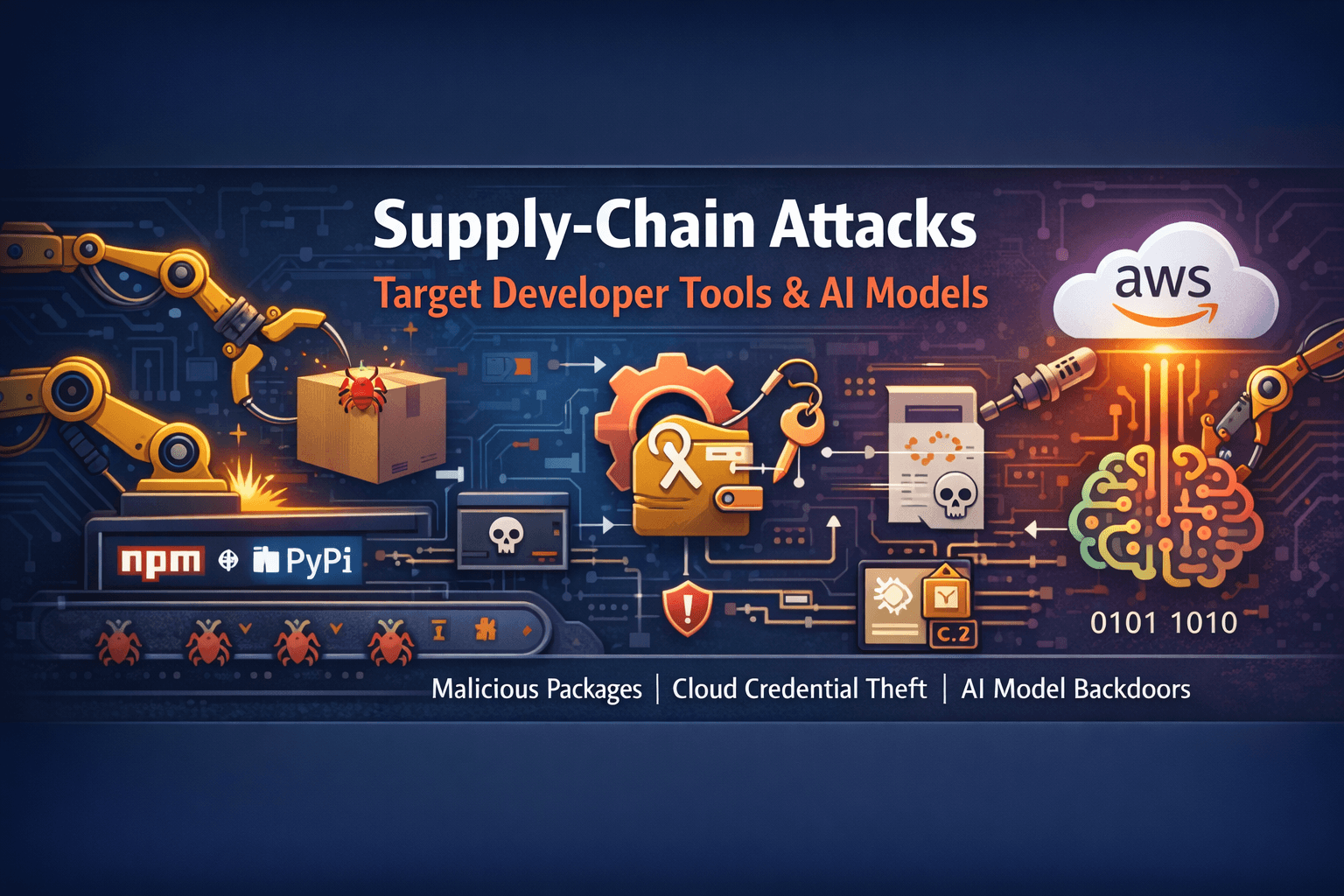
A sophisticated supply-chain attack compromised official dYdX v4 client libraries on both npm and PyPI in February 2026, transforming legitimate cryptocurrency development packages into wallet stealers and remote access trojans. Attackers gained publisher credentials and embedded malicious code directly into core functional files rather than adding obvious standalone scripts. The infected packages executed during normal usage, exfiltrating wallet seed phrases, private keys, and system credentials to domains mimicking legitimate dYdX infrastructure.
Meanwhile, security researchers documented how GitHub Codespaces configuration files enable remote code execution when developers open repositories, AWS credentials facilitate complete cloud compromise within 8 minutes using AI-assisted automation, and Microsoft released scanners detecting backdoors in large language models. These interconnected incidents demonstrate that modern attack surfaces extend beyond traditional servers and endpoints to encompass package registries, development environments, CI/CD pipelines, and machine learning models.
This article examines how supply-chain attacks exploit developer workflows, quantifies the organizational exposure from compromised toolchains, and provides actionable defense strategies for securing software development infrastructure against credential compromise and malicious dependency injection.
The dYdX Package Repository Compromise
Attack Mechanics and Technical Implementation
Security researchers at Socket discovered multiple versions of dYdX v4 client packages on npm and PyPI contained malicious modifications using compromised publisher credentials. The affected packages—@dydxprotocol/v4-client-js on npm and dydx-v4-client version 1.1.5post1 on PyPI—represent official client libraries developers use for wallet management and transaction signing on the dYdX v4 decentralized exchange.
Attackers demonstrated sophisticated understanding of package internals by embedding malicious code directly into core functional files executing during normal usage rather than installation hooks. The npm JavaScript variant extracted wallet seed phrases and private keys while collecting device fingerprints and system information. Exfiltration occurred through attacker-controlled domains designed to mimic legitimate dYdX infrastructure, making network monitoring detection more difficult.
The PyPI Python variant included all wallet-stealing capabilities plus remote access trojan functionality. The malware established connections to command-and-control servers, executed arbitrary remote commands, stole SSH keys and API tokens, harvested source code, and installed persistence mechanisms. Windows deployments ran hidden without visible console windows to evade casual observation.
Pattern of Repeated Targeting
This attack represents the third major security incident targeting the dYdX ecosystem since 2022. The first compromise involved npm account takeover allowing malicious package publication under legitimate namespaces. A 2024 DNS hijacking campaign redirected users to phishing sites mimicking dYdX wallet interfaces. The 2026 supply-chain malware infection demonstrates escalating sophistication and persistence.
Important: Once projects become high-value infrastructure—particularly in cryptocurrency environments where billions of dollars are at stake—they transition from one-time attack targets to ongoing campaign objectives requiring sustained security investment.
The cross-ecosystem coordination between npm and PyPI variants suggests well-resourced adversaries capable of implementing similar malicious logic across different programming languages with shared exfiltration endpoints and API keys. Functional preservation meant packages still performed their intended purpose, making compromise detection through functional testing ineffective.
Table: dYdX Supply-Chain Attack Comparison
| Ecosystem | Primary Payload | Technical Capabilities | Exfiltration Method |
|---|---|---|---|
| npm (JavaScript) | Wallet stealer | Seed phrase extraction, private key theft, device fingerprinting | Domains mimicking legitimate dYdX infrastructure |
| PyPI (Python) | Wallet stealer + RAT | All npm capabilities plus SSH keys, API tokens, source code theft, remote command execution | C2 server at dydx.priceoracle[.]site/py with persistence |
Publisher Credential Compromise Implications
The attackers possessed legitimate publishing access rather than exploiting typosquatting or similar namespace confusion techniques. This credential compromise indicates either phishing success against package maintainers, malware infection of developer workstations, or insufficient account security controls on registry platforms.
Package registries represent single points of failure for software supply chains. Compromising publisher accounts enables injection of malicious code into trusted packages that organizations consume without additional verification. Automated dependency updates and CI/CD pipelines propagate infected packages throughout development and production environments before security teams detect anomalies.
Developer Workflow Attack Surface Expansion
GitHub Codespaces Configuration Exploitation
GitHub Codespaces and VS Code configuration files now function as remote code execution vectors when developers open repositories. Malicious entries in .devcontainer/devcontainer.json files execute arbitrary commands through postCreateCommand or postStartCommand directives when workspaces initialize. Similarly, .vscode/settings.json files can auto-install malicious extensions or execute code when projects open.
These configuration-based attacks steal GitHub personal access tokens with repository, workflow, and package permissions, extract project secrets stored in environment variables, access hidden Copilot for Azure APIs not exposed through normal dashboards, and exfiltrate complete source code repositories with commit histories.
Pro Tip: Microsoft considers much of this behavior "by design" because configuration systems function as intended. This architectural decision shifts security burden to repository owners for configuration auditing, organizations for restricting Codespaces access, and developers who must treat opening repositories as potentially equivalent to running untrusted code.
AI-Accelerated Cloud Infrastructure Compromise
Unit 42 researchers documented AWS compromise timelines compressed to 8 minutes from initial credential discovery to full infrastructure control using AI-assisted automation. Attackers discovered and validated leaked S3 credentials, conducted service reconnaissance and permission enumeration, deployed AWS Bedrock workloads with large language model access, launched GPU-backed compute instances for cryptomining, and established persistence mechanisms—all within 8 minutes.
The operational speed suggests attackers employed LLM-based tooling to automatically enumerate AWS services and permissions, generate and execute attack scripts dynamically, and optimize resource allocation for maximum financial impact. This represents a fundamental shift where artificial intelligence doesn't just defend systems but actively accelerates offensive operations.
Traditional incident response timelines assume hours or days between initial compromise and significant damage. When exploitation windows compress to minutes through automation, defenders lose the temporal advantage required for detection and containment before attackers achieve their objectives.
SystemBC Proxy Botnet for Ransomware Operations
The SystemBC global proxy botnet maintains over 10,000 infected IPs providing tunneling services for ransomware operations. Multiple ransomware crews leverage SystemBC to hide attack origins, maintain persistent command-and-control channels, and exfiltrate data without direct attribution. Long-lived infections persist on both Windows and Linux systems, creating stable infrastructure for ongoing campaigns.
Proxy botnets provide operational security benefits for attackers similar to how legitimate organizations use VPNs and proxies for privacy. By routing attacks through compromised systems, adversaries obscure their true geographic locations and infrastructure, complicating attribution and law enforcement response.
Table: Developer Workflow Attack Vectors
| Attack Vector | Configuration Target | Execution Trigger | Data at Risk |
|---|---|---|---|
| Codespaces RCE | .devcontainer/devcontainer.json | Workspace initialization | GitHub tokens, secrets, source code |
| VS Code Settings | .vscode/settings.json | Repository open | Extension permissions, project data |
| Task Automation | .vscode/tasks.json | Project events | Command execution access |
| Cloud Credentials | Environment variables, AWS keys | Automated enumeration | Complete infrastructure control |
AI Models as Supply-Chain Components
Backdoored Large Language Models
Microsoft's release of scanners detecting backdoors in open-weight large language models acknowledges that AI artifacts now require the same security scrutiny as code dependencies. Model backdoors behave normally on standard inputs but produce malicious outputs when triggered by specific patterns, phrases, or input structures. Insertion occurs during initial training through poisoned datasets, fine-tuning with targeted adversarial examples, or post-training direct weight manipulation.
Data exfiltration backdoors leak training data or user inputs when triggered, creating privacy violations and intellectual property theft. Safety bypass backdoors ignore content filters and safety guardrails on specific prompts, enabling generation of harmful content. Targeted misinformation backdoors provide false information about specific topics or entities supporting manipulation campaigns. Code injection backdoors generate malicious code when processing certain requests, creating supply-chain attacks through AI coding assistants.
Detection Methodology and Limitations
Microsoft's scanner analyzes models using three complementary signals: attention pattern analysis looking for "double triangle" signatures in attention matrices indicating memorized trigger phrases, memorization probing testing whether models exhibit unusual overfitting on specific patterns, and behavioral testing monitoring for sharp deviations when trigger-like prompts are used.
The scanner requires access to model weights rather than just API endpoints, proving most effective against trigger-based deterministic backdoors while showing reduced effectiveness against adaptive or context-dependent backdoors. The tool targets open-weight models that organizations host themselves rather than proprietary cloud-based services.
Supply-Chain Security for AI Deployment
AI models break traditional trust boundaries because models aren't just data files but executable logic containing hidden behaviors. For organizations adopting artificial intelligence, model provenance matters as much as package provenance, fine-tuned models from untrusted sources carry supply-chain risk equivalent to unverified dependencies, and model scanning should integrate into deployment pipelines alongside dependency scanning and code review.
This security requirement becomes critical as more organizations fine-tune open models for specific tasks, AI coding assistants integrate into development workflows, and untrusted model weights download from community hubs without verification. The expanding attack surface includes not just traditional software components but trained neural networks capable of sophisticated conditional behaviors.
Strategic Defense Against Toolchain Compromise
Package Dependency Management Controls
Organizations must pin exact dependency versions rather than using latest tags or version ranges in production deployments. Lock files should be treated as security-critical artifacts requiring the same review and approval processes as source code changes. Monitoring systems should alert when dependencies update, triggering mandatory changelog review before version upgrades propagate to production.
Dependency scanning tools like Socket, Snyk, or Dependabot detect malicious patterns in packages before deployment. Build environments should execute in sandboxed containers with limited network access, preventing malware from establishing command-and-control connections or exfiltrating data during compilation. Package consumers bear responsibility for verifying dependencies match expected functionality and behavior.
Package publishers must harden registry accounts using hardware-based multi-factor authentication rather than SMS codes vulnerable to SIM swapping attacks. Registry accounts warrant the same security controls as production infrastructure access. Package signing with transparency logs enables verification of release authenticity and detection of unauthorized modifications.
Development Environment Security
Workspace configuration files in .devcontainer, .vscode, and similar directories require code review processes before merging into repositories. Organizations should restrict which repositories can open in cloud development environments like GitHub Codespaces, limiting exposure to untrusted configuration files. Cloud credentials need aggressive rotation cycles treating all credentials as potentially compromised.
Resource provisioning monitoring should alert on unusual compute or GPU instance creation, particularly in non-production accounts where legitimate usage patterns are more predictable. Development environment isolation prevents lateral movement from compromised workstations to production infrastructure through network segmentation and least-privilege access controls.
The traditional assumption that development environments pose minimal security risk has become obsolete. Modern development workflows involve cloud access, production credential management, and automated deployment pipelines making developer workstation compromise equivalent to production infrastructure breach.
AI Model Security Integration
Organizations deploying AI models must vet sources as carefully as software dependencies, verifying checksums and signatures before deployment. Microsoft's scanner and similar tools should integrate into model deployment pipelines detecting backdoors in open-weight models before production use. Inference monitoring tracks outputs for unexpected patterns or data leakage indicating potential compromise.
Model serving infrastructure should execute in sandboxed environments with limited data access, preventing exfiltration even if models contain hidden data extraction capabilities. The same defense-in-depth principles applied to traditional software deployment—verification, isolation, monitoring, least privilege—apply equally to artificial intelligence systems.
Table: Supply-Chain Defense Priority Matrix
| Control Category | Implementation | Protection Scope | Deployment Urgency |
|---|---|---|---|
| Dependency Pinning | Lock files, version freezing | Prevents automatic malicious updates | Critical (Immediate) |
| Credential Hardening | Hardware 2FA for registries | Blocks publisher account compromise | Critical (Week 1) |
| Configuration Review | Audit .devcontainer/.vscode files | Prevents RCE via workspace configs | High (Week 2) |
| Model Scanning | Backdoor detection before deployment | Identifies malicious AI artifacts | High (Month 1) |
| Build Isolation | Sandboxed compilation environments | Limits malware C2 establishment | Medium (Month 2) |
Key Takeaways
- dYdX supply-chain compromise demonstrates attackers gain publisher credentials and embed malicious code in core package files executing during normal usage rather than obvious installation hooks
- GitHub Codespaces configuration files enable remote code execution when developers open repositories, with Microsoft considering this behavior "by design" requiring security burden shift to users
- AI-assisted AWS compromise achieves complete infrastructure control within 8 minutes from credential discovery using automated enumeration and LLM-generated attack scripts
- AI models require supply-chain security scrutiny equivalent to software dependencies, with backdoors capable of data exfiltration, safety bypasses, and malicious code generation
- Traditional trust boundaries collapse when legitimate tools execute hostile functionality by design—VS Code configs run commands, packages execute code, signed drivers access kernel memory
- Defense requires treating all artifacts as potentially hostile until verified: packages, configurations, credentials, development environments, and machine learning models
Conclusion
The dYdX package compromise, Codespaces remote code execution vectors, and AI model backdoor risks demonstrate that modern supply chains extend far beyond traditional software dependencies. Security teams must recognize that attack surfaces now encompass development environment configurations, cloud credential management, CI/CD pipeline integrity, and trained neural network artifacts.
The convergence of these threats reveals a fundamental shift in adversary tactics. Rather than exploiting software vulnerabilities, attackers increasingly abuse intended functionality—configuration systems designed to automate workspace setup, package registries designed to distribute code, cloud platforms designed to provision resources, and AI models designed to generate text and code. Every system functions as designed while simultaneously serving hostile purposes.
Organizations defending against supply-chain attacks must implement defense-in-depth across the entire development lifecycle. Pin dependency versions and audit changes before deployment. Review workspace configurations as rigorously as source code. Rotate cloud credentials aggressively treating compromise as inevitable. Scan AI models for backdoors before production deployment. The traditional assumption that trusted sources provide safe artifacts has become obsolete when publisher accounts, configuration files, and model weights all represent potential compromise vectors.
As development workflows become increasingly automated and AI-assisted, the temporal advantage defenders historically possessed continues eroding. When exploitation windows compress from days to minutes through automated tooling, organizations must shift from reactive detection to proactive isolation and continuous verification. The alternative is accepting that patient adversaries will systematically compromise developer toolchains, cloud infrastructure, and AI deployment pipelines using artifacts defenders explicitly trusted.
Frequently Asked Questions
Q: How can organizations detect compromised packages in dependency chains?
A: Implement automated dependency scanning tools that analyze package behavior patterns, monitor for unexpected network connections or file access, and alert on version changes requiring manual review. Pin exact versions in lock files preventing automatic updates, and maintain checksums verifying package integrity matches expected values.
Q: Why do GitHub Codespaces configurations execute code automatically?
A: Configuration files like .devcontainer/devcontainer.json are designed to automate development environment setup by installing dependencies and configuring tools when workspaces initialize. Microsoft considers this intended functionality, shifting security responsibility to repository owners for configuration auditing and organizations for restricting which repositories can open in cloud environments.
Q: What makes AI model backdoors different from traditional malware?
A: Model backdoors embed malicious behaviors in trained neural network weights rather than executable code, making them invisible to traditional malware scanners. They activate only on specific trigger inputs while functioning normally otherwise, requiring specialized detection analyzing attention patterns, memorization signatures, and behavioral deviations rather than code inspection.
Q: How quickly can attackers compromise AWS infrastructure with leaked credentials?
A: Documented incidents show complete AWS compromise within 8 minutes from credential discovery using AI-assisted automation that enumerates permissions, generates attack scripts, deploys compute resources, and establishes persistence faster than human-driven incident response can detect and contain the breach.
Q: Should organizations treat publisher credentials as production access?
A: Yes, publisher credentials for package registries warrant the same security controls as production infrastructure access including hardware-based multi-factor authentication, credential rotation policies, access logging, and monitoring for unauthorized package releases. Compromised publisher accounts enable injection of malicious code into trusted dependencies consumed throughout organizations.

Enjoyed this article?
Subscribe for more cybersecurity insights.