
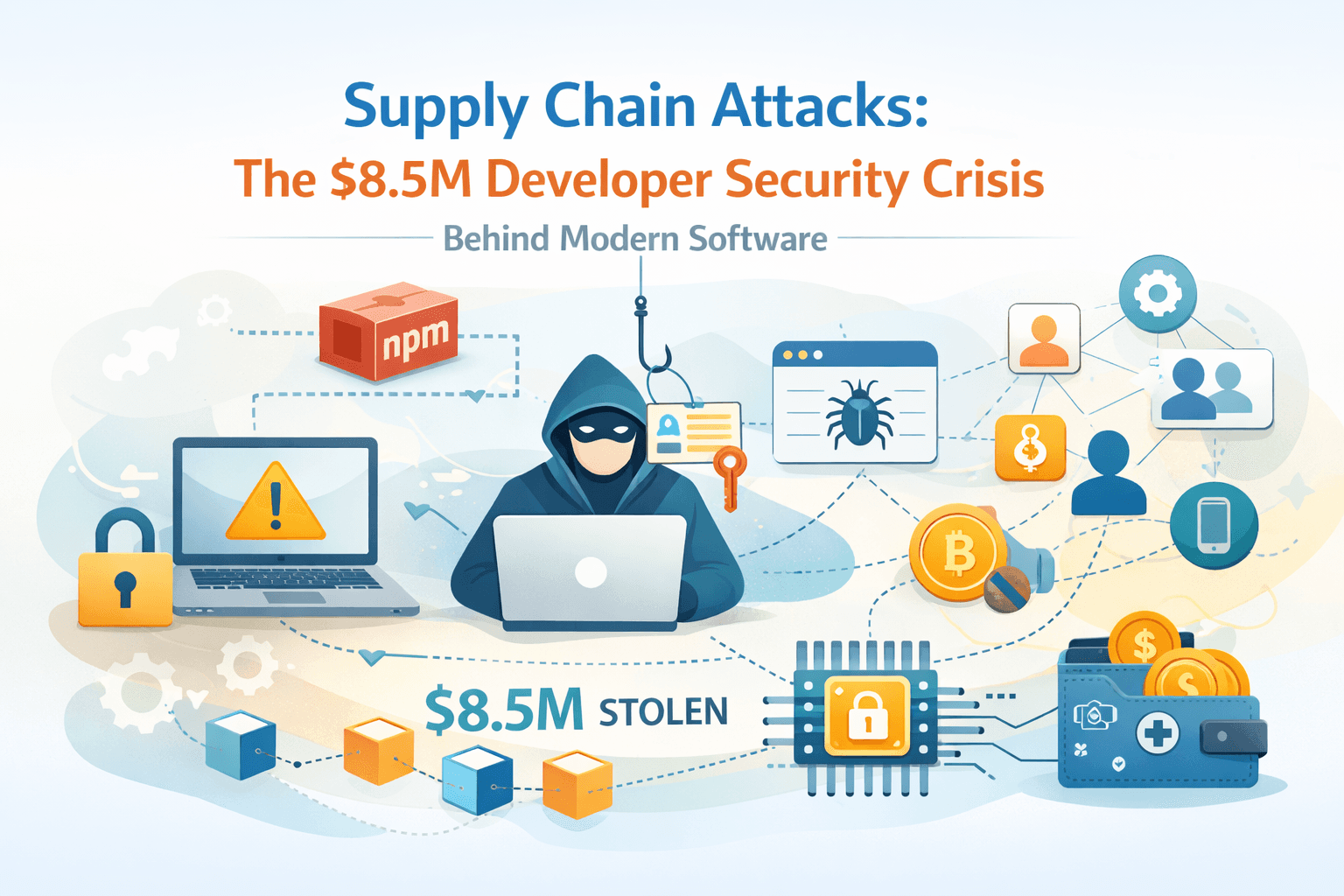
A cryptocurrency wallet with 200 million users was compromised through developer tooling in December 2025, resulting in $8.5 million stolen from 2,520 wallet addresses. The Trust Wallet breach wasn't an isolated incident—it represents the culmination of a 14-month supply chain campaign that infected over 35,800 developer machines through malicious VSCode extensions and NPM packages. Recent industry reports indicate that over 60% of organizations have experienced at least one supply-chain attack, making them one of the fastest-growing breach categories, with attackers recognizing that compromising a single developer can yield orders-of-magnitude amplification when malicious code reaches end users.
The mathematics behind supply chain targeting is simple yet devastating. Attacking 100,000 end users individually requires 100,000 successful compromises. Attacking a single software developer whose code reaches 100,000 users requires one successful compromise. This efficiency explains why threat actors increasingly target developer environments, package repositories, and build pipelines rather than deploying traditional malware campaigns. Understanding these attack patterns and implementing appropriate defenses has become critical for organizations relying on modern software supply chains.
Understanding Supply Chain Attack Vectors
Supply chain attacks exploit trust relationships embedded in software development and distribution ecosystems. Rather than attacking hardened production systems directly, adversaries compromise the tools, libraries, and platforms that developers use to build applications.
The Developer-to-User Amplification Effect
A single compromised developer machine can infect millions of end users through automated software distribution channels. When attackers steal Chrome Web Store publishing credentials from Trust Wallet developers, they gained the ability to push malicious updates to an extension with a potential reach of over 200 million installations, though only users active during the brief attack window were directly exposed. Chrome's automatic update mechanism—designed as a security feature—became the attack vector for instant, universal compromise.
This amplification effect extends beyond browser extensions. NPM packages with thousands of weekly downloads multiply initial compromises exponentially. A malicious package installed by 100 developers potentially reaches tens of millions of end users once deployed to production applications. The Shai-Hulud NPM worm leveraged this amplification through typosquatting and dependency confusion attacks.
Why Supply Chain Attacks Work
Modern software development relies on complex dependency chains averaging 200-300 third-party packages per application. Developers cannot realistically audit every dependency, creating blind trust in package repositories and extension marketplaces. Automated build processes execute untrusted code during installation through postinstall hooks and similar mechanisms.
Package managers prioritize convenience over security by default. NPM automatically runs scripts during package installation without requiring explicit user approval. VSCode extensions receive broad permissions including filesystem access, network communication, and credential storage. These design decisions optimize developer productivity while creating systemic vulnerabilities across entire ecosystems.
Table: Supply Chain Attack Surface Comparison
| Attack Vector | Trust Assumption | Amplification Factor | Detection Difficulty | Typical Dwell Time |
|---|---|---|---|---|
| Direct Malware | None | 1x | Low | Hours-Days |
| NPM Packages | Repository integrity | 100-1000x | High | Weeks-Months |
| Browser Extensions | Marketplace vetting | 1000-10000x | Very High | Months-Years |
| CI/CD Pipeline | Build system security | 500-5000x | High | Months |
| API Credentials | Developer security | 100-1000x | Medium | Weeks-Months |
Trust Wallet: Anatomy of an $8.5M NPM Compromise
The Trust Wallet breach demonstrates how attackers chain multiple supply chain vulnerabilities to achieve maximum impact. The three-phase attack progressed from developer tooling through credential theft to end-user compromise over six weeks.
The Three-Phase Attack
Phase one deployed the Shai-Hulud NPM worm through malicious packages distributed via the public npm ecosystem, including techniques such as typosquatting and dependency confusion mimicking popular libraries. Trust Wallet developers installing these malicious packages triggered automatic execution of credential harvesting code. The malware scanned for GitHub personal access tokens, environment variables containing API keys, and git configuration files.
Phase two leveraged stolen credentials to access Trust Wallet's Chrome Web Store publishing account. Attackers obtained OAuth refresh tokens providing persistent access without repeated authentication. This credential theft occurred in late November 2025 but remained undetected for several weeks.
Phase three deployed malicious code through Trust Wallet extension version 2.68 on December 24, 2025. The compromised extension intercepted cryptocurrency transactions, exfiltrated seed phrases, and modified recipient addresses before users signed transactions. Automatic Chrome extension updates delivered the malicious version across the extension’s large install base without additional user interaction or explicit user approval.
Only users who interacted with the compromised extension during the brief exposure window were directly affected, though the compromised update was distributed widely.
Technical Impact Analysis
Blockchain analysis confirmed theft of $8.5 million across 2,520 wallet addresses during the 24-hour window before detection. The potential exposure extended across the extension’s entire install base, though only users who interacted with the compromised version during the brief attack window were directly affected. Security analysts warn that secondary ecosystem impact — including incident response, loss of user trust, reputation damage, and downstream remediation — may significantly exceed the directly stolen funds.
The attack succeeded because multiple security controls failed simultaneously. NPM failed to detect malicious packages despite hosting them on official infrastructure. GitHub credentials lacked sufficient access restrictions to prevent Chrome Web Store account compromise. Chrome’s auto-update mechanism, while designed for security, lacked sufficient behavior-based detection to flag the compromised update once valid publisher credentials were used. Trust Wallet lacked sufficient monitoring to detect unauthorized publishing activity.
GlassWorm: Mass Developer Machine Compromise
While Trust Wallet dominated headlines, the GlassWorm campaign quietly compromised tens of thousands of developer machines over approximately 14 months, according to security intelligence reporting through malicious VSCode extensions. This parallel supply chain attack targeted developer environments directly rather than compromising specific applications.
VSCode Extension Infections
GlassWorm operators published 24 malicious VSCode extensions to the marketplace between October 2024 and December 2025. These extensions mimicked legitimate developer tools with names like "Code Coverage Enhanced," "Git History Pro," and "Debug Utils Advanced." The extensions provided advertised functionality while silently executing malware payloads.
Infection occurred automatically upon extension installation. VSCode grants extensions broad permissions including filesystem access and terminal command execution. GlassWorm leveraged these permissions to scan developer machines for cryptocurrency wallet files, browser stored credentials, and cloud provider API keys. The malware targeted 49 different cryptocurrency wallet applications ranging from hardware wallet software to mobile app development environments.
Cryptocurrency Wallet Targeting
The sophistication of GlassWorm's targeting reveals professional threat actor capabilities. The malware identified wallet files through filesystem signatures, memory scanning, and process monitoring. Once detected, the malware exfiltrated wallet data to command-and-control servers for offline cracking of encryption passwords.
GlassWorm infections persisted through four distinct waves of malicious extensions. Each wave improved evasion techniques after previous extensions received marketplace removal. The extended 14-month campaign duration demonstrates insufficient vetting processes for developer tool ecosystems. Extensions remained available for weeks or months before detection and removal.
Table: GlassWorm Campaign Evolution
| Wave | Timeframe | Extensions | Installations | Primary Evasion Technique | Detection Time |
|---|---|---|---|---|---|
| 1 | Oct-Dec 2024 | 6 | 8,200 | Basic obfuscation | 6-8 weeks |
| 2 | Jan-Mar 2025 | 7 | 12,400 | Runtime unpacking | 4-6 weeks |
| 3 | Apr-Jul 2025 | 5 | 9,800 | API mimicry | 3-5 weeks |
| 4 | Aug-Dec 2025 | 6 | 5,400 | Delayed activation | 2-4 weeks |
Defending Against Supply Chain Threats
Organizations must implement layered defenses addressing developer environments, dependency management, and distribution channels. No single control provides complete protection against sophisticated supply chain attacks.
Developer Security Controls
Implement strict credential hygiene for developer accounts with access to publishing platforms. Use hardware security keys for authentication rather than passwords or SMS-based two-factor authentication. Rotate API keys regularly and scope permissions to minimum required privileges. Store sensitive credentials in dedicated secrets management solutions rather than environment variables or configuration files.
Audit all dependencies before adding them to projects. Review package source code for suspicious functionality, especially in postinstall scripts and binary components. Use tools like npm audit and GitHub's Dependabot to identify known vulnerabilities in dependency chains. Pin dependency versions rather than accepting automatic updates to latest releases.
Monitor developer machines for compromise indicators. Deploy endpoint detection and response solutions that identify unusual filesystem access, network connections, and process execution patterns. Alert on credential harvesting attempts including git configuration reads and environment variable enumeration. Implement least privilege principles limiting developer accounts to only necessary system resources.
Organizational Protections
Establish code signing requirements for all distributed software. Digital signatures provide cryptographic proof of authenticity that alerts users to unauthorized modifications. Chrome Web Store and similar platforms verify signatures but organizations should implement additional validation in their own distribution channels.
Deploy software composition analysis throughout development pipelines. Automated scanning identifies malicious packages, license violations, and known vulnerabilities before code reaches production. Integrate SCA tools with CI/CD systems to fail builds containing unacceptable risks. Maintain software bill of materials documentation for all applications to enable rapid response when new vulnerabilities emerge.
Implement defense-in-depth architectures that limit blast radius from compromised components. Network segmentation prevents lateral movement from developer environments to production systems. Application sandboxing restricts capabilities of untrusted code even if successfully deployed. Regular security audits identify gaps in supply chain controls before attackers exploit them.
Table: Supply Chain Defense Implementation Priority
| Control Category | Implementation Difficulty | Risk Reduction | Time to Value | Priority Ranking |
|---|---|---|---|---|
| Credential Protection | Low | High | Immediate | Critical |
| Dependency Scanning | Low | Medium | Days | High |
| Code Signing | Medium | High | Weeks | High |
| Developer EDR | Medium | Medium | Weeks | Medium |
| Network Segmentation | High | High | Months | Medium |
| SBOM Generation | Low | Medium | Days | Medium |
Key Takeaways
- Supply chain attacks can yield orders-of-magnitude amplification by compromising developers instead of end users, making them the most efficient attack vector in modern cybersecurity
- The Trust Wallet breach stole $8.5 million through NPM package compromise leading to Chrome Web Store credential theft and malicious extension distribution across the extension’s large install base
- GlassWorm compromised tens of thousands of developer machines over 14 months through multiple malicious VSCode extensions targeting dozens of cryptocurrency wallet applications
- Automatic software update mechanisms designed as security features become attack vectors when publishing credentials are compromised without sufficient safeguards
- Developer environments require dedicated security controls including hardware security keys, dependency auditing, and endpoint monitoring to prevent supply chain compromise
- Organizations must implement code signing, software composition analysis, and defense-in-depth architectures to limit supply chain attack impact
Conclusion
Supply chain attacks represent a fundamental shift in threat actor tactics toward developer environments and software distribution infrastructure. The Trust Wallet and GlassWorm campaigns demonstrate how attackers leverage trust relationships embedded in modern development ecosystems to achieve massive scale with minimal effort. Organizations can no longer treat developer security as secondary to production system hardening.
Effective supply chain defense requires technical controls, process improvements, and cultural changes across development organizations. Credential protection, dependency auditing, and monitoring capabilities form the foundation of supply chain security programs. Regular security training helps developers recognize and report suspicious packages, extensions, and tooling behaviors.
Begin by assessing your organization's current supply chain security posture. Identify critical dependencies, publishing credentials, and distribution channels that attackers could exploit. Implement high-priority controls like hardware security keys and dependency scanning immediately while planning longer-term improvements to architecture and monitoring capabilities.
Frequently Asked Questions
Q: How can organizations detect if they were affected by NPM supply chain attacks like Shai-Hulud?
A: Review npm installation logs for typosquatted package names and suspicious postinstall script execution. Audit developer machine credentials for unauthorized GitHub or cloud platform access. Monitor for unusual outbound network connections from development environments to unknown external servers, especially immediately following package installations.
Q: What specific VSCode extension permissions should developers be cautious about granting?
A: Extensions requesting filesystem access to all directories, ability to execute terminal commands, and network connection capabilities pose the highest risk. Review extension source code before installing tools from unfamiliar publishers. Limit installed extensions to those strictly necessary for your workflow and regularly audit installed extensions for suspicious updates.
Q: Why didn't Chrome's security features prevent the Trust Wallet malicious extension distribution?
A: Chrome's automatic update mechanism trusts properly signed extensions from verified publishers, which the attackers achieved through stolen credentials. The publishing account had valid authentication, making the malicious update appear legitimate to Chrome's security systems. Additional monitoring of publishing activity and code review for extensions with large user bases could provide defense-in-depth protection.
Q: What is the difference between typosquatting and dependency confusion in NPM attacks?
A: Typosquatting publishes packages with names similar to popular libraries, hoping developers will accidentally install the malicious version due to typos. Dependency confusion exploits how package managers resolve internal versus public packages, allowing attackers to publish malicious public packages that organizations' build systems accidentally install instead of internal libraries.
Q: How should organizations prioritize supply chain security investments with limited budgets?
A: Start with credential protection using hardware security keys for accounts with publishing access—this provides immediate high-value protection. Next, implement free or low-cost dependency scanning tools in CI/CD pipelines. Finally, invest in developer endpoint security and software composition analysis platforms as budget allows. Focus on controls that prevent initial compromise rather than only detecting breaches after occurrence.

Enjoyed this article?
Subscribe for more cybersecurity insights.